"You tricked it! It dies." - Alternate Reality: The City
What if you could only counter a Feint, Ruse, or Beat with the same attribute used against you, or take a penalty?
Right now, a Beat can be resisted by ST or DX based skill. A Ruse by IQ or DX based skill. A Feint by DX based skill. In other words, you can always resist a defense-lowering contest with DX-based skill. Since most warrior-types get both a high DX and a high skill, this means that Beats and Ruses are generally only useful* if you're stronger or smarter than you are agile, and no harder to counter by weak or dumb guys.
One idea I've been toying with is that you can either:
- resist with the same controlling attribute as you were Feinted/Rused/Beaten with (DX, IQ, ST)
OR
- suffer a penalty and substitute in DX.
This would mean that, say, an Ogre (ST 20, DX 12, IQ 7, weapon skill at DX+2) could Beat at 22, against an elf (ST 10, DX 14, IQ 12, weapon skill at DX+4) who would either use 14 (ST + skill) or 18 minus some penalty. But that elf could use a Ruse at 16 vs. the ogre's 9, or the ogre could try to recover with his agility and skill at 14 minus some penalty.
It's determining what a fair penalty for substitution would be that's got me hung up. In the example, even a -4 for substitution means the ogre is still better off substituting his DX and getting a net 10 than his brains with a 9, and the elf rolls a 14 either way. A sliding penalty isn't typical for GURPS and isn't very fun to recalculate in play, either.
But I like the idea that "recover with my skill" (aka DX-based feint resistance) works best when it's a straight-up question of skill, but doesn't work as well against brute strength or when someone is trying to trick you.
So my current musing is, how do I set an appropriate penalty, and then, how will it work out in play?
* Leaving aside that Beat has some very specific benefits and limitations that make it unlike Feint and Ruse, of course.
Thursday, October 10, 2013


Wednesday, October 9, 2013
Megadungeon Lessons from the Pyramids
When I'm not writing about games or being a trainer, I'm also an ESL teacher. Recently I had a couple students come to me with projects on the pyramids.* Pyramids are a good example of how megadungeons can come about.
I'll skip Why, because Why influences the game very heavily. Let's look at a bit of how, and what that can give you in terms of detail.
How did they build it? Usually the explanation involves magical stone-shaping, strange subterranean races, and mystical gobbledegook. However, like the pyramids, a megadungeon can simply be a straight up application of a magical formula: manpower + a guiding intent + time = lots of work completed. If someone with enough resources and enough will to apply them gets folks digging, you can get a pretty big hole. Looking at a megadungeon from the perspective a long-term project.
It's how Stonehell got built - stick enough people in a small set of tunnels and tell them to dig, and you'll get a big set of tunnels.
If your dungeon was dug out as a big project, you're likely to find some these little bits:
Dungeon Graffiti - Dungeon builders will not just leave mystic marks of their passing, but also marks about who built it. You'll get work crews signing their names, leaving their marks - they find a lot of this stuff in pyramids. Why not in megadungeons, stuck behind some door or on top of a lintel, or behind that giant idol that was put in at the end? Not all "kilroy" marks will be adventurers or monsters - some can be from its initial construction days.
Dungeon Construction Marks - You may even find official marks - an "Inspected by 34" note or a stamp or seal to denote when a section was considered done. Faded paint or ink marks to show what's behind something (like road workers leave when finished doing sewer work.) Doors on man-made levels might have specific marks or types to show you what's in the room beyond. My own Felltower has some storerooms, and near one set there were still wall sections marked with cryptic content marks, for easy inspection. The marks were wrong, by the by, but it made it clear what the rooms were originally.
Incidentally you won't find a lot of "finished" marks near a partially done section - so if PCs learn these they can tell a collapsed area from a never-finished area.
Builder Trash - Broken pottery from packed lunches and drinks shows up near pyramids, but not in them. Fair enough, you won't leave trash behind in a sacred tomb. Nearby is fine - and megadungeons are often presented as a complex of sections. So you might find disused staging areas with broken bits of trash, odd bits of what seem like useless materials, etc. meant for digging. It might even show up on the surface, in trash heaps used when disposing of talus and debris and corpses (if the workers were unvalued slaves instead of volunteers or paid workers). Not much loot, there, perhaps, but good color for "how was this done?" Nothing says hard work like centuries of piled up beer bottles near the dungeon.
I'll skip Why, because Why influences the game very heavily. Let's look at a bit of how, and what that can give you in terms of detail.
How did they build it? Usually the explanation involves magical stone-shaping, strange subterranean races, and mystical gobbledegook. However, like the pyramids, a megadungeon can simply be a straight up application of a magical formula: manpower + a guiding intent + time = lots of work completed. If someone with enough resources and enough will to apply them gets folks digging, you can get a pretty big hole. Looking at a megadungeon from the perspective a long-term project.
It's how Stonehell got built - stick enough people in a small set of tunnels and tell them to dig, and you'll get a big set of tunnels.
If your dungeon was dug out as a big project, you're likely to find some these little bits:
Dungeon Graffiti - Dungeon builders will not just leave mystic marks of their passing, but also marks about who built it. You'll get work crews signing their names, leaving their marks - they find a lot of this stuff in pyramids. Why not in megadungeons, stuck behind some door or on top of a lintel, or behind that giant idol that was put in at the end? Not all "kilroy" marks will be adventurers or monsters - some can be from its initial construction days.
Dungeon Construction Marks - You may even find official marks - an "Inspected by 34" note or a stamp or seal to denote when a section was considered done. Faded paint or ink marks to show what's behind something (like road workers leave when finished doing sewer work.) Doors on man-made levels might have specific marks or types to show you what's in the room beyond. My own Felltower has some storerooms, and near one set there were still wall sections marked with cryptic content marks, for easy inspection. The marks were wrong, by the by, but it made it clear what the rooms were originally.
Incidentally you won't find a lot of "finished" marks near a partially done section - so if PCs learn these they can tell a collapsed area from a never-finished area.
Builder Trash - Broken pottery from packed lunches and drinks shows up near pyramids, but not in them. Fair enough, you won't leave trash behind in a sacred tomb. Nearby is fine - and megadungeons are often presented as a complex of sections. So you might find disused staging areas with broken bits of trash, odd bits of what seem like useless materials, etc. meant for digging. It might even show up on the surface, in trash heaps used when disposing of talus and debris and corpses (if the workers were unvalued slaves instead of volunteers or paid workers). Not much loot, there, perhaps, but good color for "how was this done?" Nothing says hard work like centuries of piled up beer bottles near the dungeon.
Tuesday, October 8, 2013
Thinking about my Bones II backing out loud
I'm in on Bones II, as I discussed before.
I've been debating what beyond the basic Vampire set to get.
There are a lot of Dragons - I sure don't need dragons. Don't get me wrong, I like them. But I have dragon minis already. I even have a big Reaper dragon boxed set (Gauth), that I can't put together because I have no where to keep a giant fragile dragon. He's pretty much in the same place my 1/25 model Pzkw VI Tiger tank is in - in a box, until I own a house with room for a display case. Bonesium ones would be more convenient but how many dragons do I need and can I store?
The Kraken is the same - $15 for a giant freaking squid! Awesome! Except where do I keep it? It'd be hard to use in play, too.
Some sets just add things I don't want (mouselings) or have enough of (big demons) or paints or dungeon decor (cool, but I think I make my own). I wouldn't turn them down as free additions to the core but I won't pay extra to get them.
What should I get?
Maybe Lesser Devils because, hey, I can always use more supernatural demon things, and $10 for 2 big ones and a few small ones is a good deal.
The Oh Rats! set looks cool. Sadly they changed it from five little rat guys and a giant rat-man to four little rat guys, a dwarf (?), a gopher centaur, and a giant rat man. It's kind of disappointing because if I add this on I'm trading 1 mini I wanted for 2 I don't want. Kind of drags the value down for me. If I get this set that gopher dude and dwarf go right into the trade pile.
The Core Expansion #1 is an interesting idea - and from a shipping standpoint, it makes a lot of sense. You glom them together into a single SKU, basically, and it's either send one or don't send it. Smooths the fulfillment process.
But I'm still iffy on it. It's $50 for a lot of stuff, but most of it I don't want. I like that dragon turtle. I could use those derro (if only from nostalgia when I used them heavily in a previous game), and I like those hordlings. I also like the cultists from the final expansion. Oh, and the goblin leaders and mushroom men are pretty cool. I'm not sure I'm going to go for it - I'm leaning towards no. I think $50 will get me all the ones I like and none of the ones I don't. What I need to find is someone who wants the stuff I don't and split it between us.
I'm hoping they allow an a la carte additions later, so I can grab some of them. They might only let you do it if you have the Core Expansion they're from, which would suck. From the core Vampire set there are some things I could use extras of.
We'll see, but right now a lot is riding on letting me get stuff a la carte. I'd like to get my pledge all together and finalized during the Kickstarter, not after, to up the amount of freebie adds.
Lots to think about - and since I expect a U-shaped curve of pledges and a final surge (from folks like me, waiting to see what's really available), I may need to make those decisions very much last minute.
I've been debating what beyond the basic Vampire set to get.
There are a lot of Dragons - I sure don't need dragons. Don't get me wrong, I like them. But I have dragon minis already. I even have a big Reaper dragon boxed set (Gauth), that I can't put together because I have no where to keep a giant fragile dragon. He's pretty much in the same place my 1/25 model Pzkw VI Tiger tank is in - in a box, until I own a house with room for a display case. Bonesium ones would be more convenient but how many dragons do I need and can I store?
The Kraken is the same - $15 for a giant freaking squid! Awesome! Except where do I keep it? It'd be hard to use in play, too.
Some sets just add things I don't want (mouselings) or have enough of (big demons) or paints or dungeon decor (cool, but I think I make my own). I wouldn't turn them down as free additions to the core but I won't pay extra to get them.
What should I get?
Maybe Lesser Devils because, hey, I can always use more supernatural demon things, and $10 for 2 big ones and a few small ones is a good deal.
The Oh Rats! set looks cool. Sadly they changed it from five little rat guys and a giant rat-man to four little rat guys, a dwarf (?), a gopher centaur, and a giant rat man. It's kind of disappointing because if I add this on I'm trading 1 mini I wanted for 2 I don't want. Kind of drags the value down for me. If I get this set that gopher dude and dwarf go right into the trade pile.
The Core Expansion #1 is an interesting idea - and from a shipping standpoint, it makes a lot of sense. You glom them together into a single SKU, basically, and it's either send one or don't send it. Smooths the fulfillment process.
But I'm still iffy on it. It's $50 for a lot of stuff, but most of it I don't want. I like that dragon turtle. I could use those derro (if only from nostalgia when I used them heavily in a previous game), and I like those hordlings. I also like the cultists from the final expansion. Oh, and the goblin leaders and mushroom men are pretty cool. I'm not sure I'm going to go for it - I'm leaning towards no. I think $50 will get me all the ones I like and none of the ones I don't. What I need to find is someone who wants the stuff I don't and split it between us.
I'm hoping they allow an a la carte additions later, so I can grab some of them. They might only let you do it if you have the Core Expansion they're from, which would suck. From the core Vampire set there are some things I could use extras of.
We'll see, but right now a lot is riding on letting me get stuff a la carte. I'd like to get my pledge all together and finalized during the Kickstarter, not after, to up the amount of freebie adds.
Lots to think about - and since I expect a U-shaped curve of pledges and a final surge (from folks like me, waiting to see what's really available), I may need to make those decisions very much last minute.
Sunday, October 6, 2013
The Game Isn't In The Books
The map is not the territory.
The rules are not the game play.
Rules analysis isn't game play.
And the rules are not what went into building the rules.
The game is not what's in the books. The game is what's happening on the table.
Reading RPGs, it's easy to get fooled by this. You've got these big books (or little brown books, whatever) of rules. But they aren't complete - they aren't complete until you play with them. And then what happens in play is the thing, not what led you there.
It's easy to get led astray. This is where I think a lot of rules lawyering comes from, this is where accusations of unfair GMing can come from, this is where bickering and arguing can start. It's the idea that what's in the books (or not in the books) is the game. The idea that if the books say X or Y, that's what they say and how it goes and it's unfair if it doesn't happen that way. And if the books don't say you can't do Z, you can do Z, because they don't forbid it so it's unfair if the GM does. The books aren't the game.
The game is what's going on at the table. Don't look in the books for your fun - the fun is right there in front of you. The books, to paraphrase Enter the Dragon, are the finger pointing towards the moon. The play is the moon.
Even when the GM contradicts the books or the books contradict the GM, that's not something to stop play over. Keep going, have your fun, and if it's a big issue for you talk about it before next time. There will be a next time, if you don't ruin it focusing on the books, the rules, and the arguments.
Don't conflate game analysis with game play.
Whether it's Len Lakofka's mathematical analysis of weapon specialization effects on combat in AD&D or a per-trove look at treasure in D&D or exploring an optimum GURPS Dungeon Fantasy delving group - it's just analysis. It tells you something about the results you can expect over lots of iterations of play. But it's not play. It's not how the game works. D&D isn't about number-crunching ("I need 1.2 more delves to get to level 3, boys! Let's go!") GURPS isn't about point optimization. You can do these things, but they aren't what the game is about.
It's fun and useful to do analysis. But it's not how the game plays. Those are the win-loss statistics, not the championship game.
This is especially important to keep in mind when reading about a game you haven't played. You'll learn something about it, maybe something important or useful, but you won't really learn what it's like to play it out with your friends. Until you do that thing, which is where the hobby happens.
You Don't Have to Get Under the Hood
Complexity under the hood can stay there. I drive a hybrid car, but I couldn't make one (or really explain how it does all the stuff it does). Games are like this, too - if someone does hard core analysis and game design and playtesting to make sure the game works as intended and encourages rather than impedes fun play, that's enough. You don't really ever have to get into those numbers if you don't want to.
Doug Cole's "The Deadly Spring" was fairly accurately described as " the most infamous Pyramid article of all time." It could be - over 11,000 words and complex mathematics to determine the particulars of any kind of bow, from its constructions and draw strength to its game statistics. Pretty complex stuff. Serious work and serious research went into it.
But you could play in a game with it and not even know. If I used it to make a list of bows and then handed it to you and said "pick one for your guy," you could, without knowing why I settled on a set of stats. It's "I did all this work so you don't have to" combined with "and because I thought it would make the game more fun when we play." I could have just made stuff up, too, and you could be happy with that ("Bows do 1d6 damage," say), if I was sure it would be just as satisfying to all. But once done, you don't really need to do all that work again - or interact with it on the same level of complexity that it took to do the work.
This ties back into the article I wrote about GURPS and gearheads. There are a lot of knobs and dials you can fidget with, but once they're all set you can just play without paying much attention to them. That's another reason I harp so much on actual play - what looks like tremendously intricate detail that will grind play to a halt might be that . . . but it might just be details under the surface you can just ignore.
What's under the hood can usually stay there. Not always - if poorly done, or obtrusive, or with the wrong kind of group, they can become the game. They can get some important in people's minds, or so intrusive in use, that they get in the way. But that's where the first thing I mentioned is important - you have to learn to separate out what's in the books (or on your sheet) with what's going on the spoken space above and around the table. That's where the real fun happens, if you can peel your eyes away from that pointing finger.
The rules are not the game play.
Rules analysis isn't game play.
And the rules are not what went into building the rules.
The game is not what's in the books. The game is what's happening on the table.
Reading RPGs, it's easy to get fooled by this. You've got these big books (or little brown books, whatever) of rules. But they aren't complete - they aren't complete until you play with them. And then what happens in play is the thing, not what led you there.
It's easy to get led astray. This is where I think a lot of rules lawyering comes from, this is where accusations of unfair GMing can come from, this is where bickering and arguing can start. It's the idea that what's in the books (or not in the books) is the game. The idea that if the books say X or Y, that's what they say and how it goes and it's unfair if it doesn't happen that way. And if the books don't say you can't do Z, you can do Z, because they don't forbid it so it's unfair if the GM does. The books aren't the game.
The game is what's going on at the table. Don't look in the books for your fun - the fun is right there in front of you. The books, to paraphrase Enter the Dragon, are the finger pointing towards the moon. The play is the moon.
Even when the GM contradicts the books or the books contradict the GM, that's not something to stop play over. Keep going, have your fun, and if it's a big issue for you talk about it before next time. There will be a next time, if you don't ruin it focusing on the books, the rules, and the arguments.
Don't conflate game analysis with game play.
Whether it's Len Lakofka's mathematical analysis of weapon specialization effects on combat in AD&D or a per-trove look at treasure in D&D or exploring an optimum GURPS Dungeon Fantasy delving group - it's just analysis. It tells you something about the results you can expect over lots of iterations of play. But it's not play. It's not how the game works. D&D isn't about number-crunching ("I need 1.2 more delves to get to level 3, boys! Let's go!") GURPS isn't about point optimization. You can do these things, but they aren't what the game is about.
It's fun and useful to do analysis. But it's not how the game plays. Those are the win-loss statistics, not the championship game.
This is especially important to keep in mind when reading about a game you haven't played. You'll learn something about it, maybe something important or useful, but you won't really learn what it's like to play it out with your friends. Until you do that thing, which is where the hobby happens.
You Don't Have to Get Under the Hood
Complexity under the hood can stay there. I drive a hybrid car, but I couldn't make one (or really explain how it does all the stuff it does). Games are like this, too - if someone does hard core analysis and game design and playtesting to make sure the game works as intended and encourages rather than impedes fun play, that's enough. You don't really ever have to get into those numbers if you don't want to.
Doug Cole's "The Deadly Spring" was fairly accurately described as " the most infamous Pyramid article of all time." It could be - over 11,000 words and complex mathematics to determine the particulars of any kind of bow, from its constructions and draw strength to its game statistics. Pretty complex stuff. Serious work and serious research went into it.
But you could play in a game with it and not even know. If I used it to make a list of bows and then handed it to you and said "pick one for your guy," you could, without knowing why I settled on a set of stats. It's "I did all this work so you don't have to" combined with "and because I thought it would make the game more fun when we play." I could have just made stuff up, too, and you could be happy with that ("Bows do 1d6 damage," say), if I was sure it would be just as satisfying to all. But once done, you don't really need to do all that work again - or interact with it on the same level of complexity that it took to do the work.
This ties back into the article I wrote about GURPS and gearheads. There are a lot of knobs and dials you can fidget with, but once they're all set you can just play without paying much attention to them. That's another reason I harp so much on actual play - what looks like tremendously intricate detail that will grind play to a halt might be that . . . but it might just be details under the surface you can just ignore.
What's under the hood can usually stay there. Not always - if poorly done, or obtrusive, or with the wrong kind of group, they can become the game. They can get some important in people's minds, or so intrusive in use, that they get in the way. But that's where the first thing I mentioned is important - you have to learn to separate out what's in the books (or on your sheet) with what's going on the spoken space above and around the table. That's where the real fun happens, if you can peel your eyes away from that pointing finger.
Saturday, October 5, 2013
Upcoming Dungeon Fantasy Article PSA
As mentioned by Sean "Dr. Kromm" Punch, he and I collaborated on a new Dungeon Fantasy-related article for Pyramid magazine.
When it'll come out, I don't know. But when I mentioned springboarding off of other people's ideas, it was that right there. I had an idea percolating, based on my game, and when I saw Sean's stuff, it really got my ideas to coalesce nicely. And I know he took one of my ideas and went somewhere with it I'd never have gone on my own . . . but should have.
What is the article all about?
Naturally, it's fantasy game and combat related, because it's Sean and me.
So it'll be some more stuff to spend you DF characters hard-won experience points on, if you survive the dungeon . . .
When it'll come out, I don't know. But when I mentioned springboarding off of other people's ideas, it was that right there. I had an idea percolating, based on my game, and when I saw Sean's stuff, it really got my ideas to coalesce nicely. And I know he took one of my ideas and went somewhere with it I'd never have gone on my own . . . but should have.
What is the article all about?
Naturally, it's fantasy game and combat related, because it's Sean and me.
So it'll be some more stuff to spend you DF characters hard-won experience points on, if you survive the dungeon . . .
Friday, October 4, 2013
Felltower's Cone-Hatted Cultists
Here are four of those cone-hatted cultists the PCs have interacted with a couple times in my DF game.

They're just Mordheim Possessed, as far as I can remember. I bought them because of how cool they looked, and painted them up with a clear aim to use them as crazed cultists in a game. When I started in on Felltower, I went right for them as my go-to crazies and baked them right into the system.
They are covered with a few layers of "Tapestry Wine" craft paint, and shiny highlight details (skulls, glossy black weaponry, silvered metal studs) to bring out the black and red. They're nothing more than tabletop worthy, but they convey a real sense of "these guys worship someone bad" with the color scheme and that's all I needed.
I use a lot of Mordheim minis in my games. They've got a lot of personality, which makes for fun enemies or "are we sure about this guy?" hirelings.
These guys will be back, if only because I like the minis. And because crazed cultists come in mobs, not tiny groups.
I also started in on four of my Bones minis (and got pretty far), put final post-sealer touches on two more, and start-to-finish painted three more. It was warm the past few days, and I ended up with a little free time on Tuesday and Wednesday, and a tiny bit more last night. That was all I needed to get in two short but productive painting sessions.
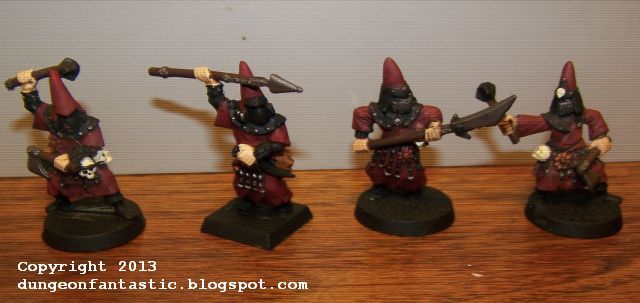
They're just Mordheim Possessed, as far as I can remember. I bought them because of how cool they looked, and painted them up with a clear aim to use them as crazed cultists in a game. When I started in on Felltower, I went right for them as my go-to crazies and baked them right into the system.
They are covered with a few layers of "Tapestry Wine" craft paint, and shiny highlight details (skulls, glossy black weaponry, silvered metal studs) to bring out the black and red. They're nothing more than tabletop worthy, but they convey a real sense of "these guys worship someone bad" with the color scheme and that's all I needed.
I use a lot of Mordheim minis in my games. They've got a lot of personality, which makes for fun enemies or "are we sure about this guy?" hirelings.
These guys will be back, if only because I like the minis. And because crazed cultists come in mobs, not tiny groups.
I also started in on four of my Bones minis (and got pretty far), put final post-sealer touches on two more, and start-to-finish painted three more. It was warm the past few days, and I ended up with a little free time on Tuesday and Wednesday, and a tiny bit more last night. That was all I needed to get in two short but productive painting sessions.
Thursday, October 3, 2013
GURPS - Just for Gearheads?
There is a very strong meme out there that GURPS is for gearheads. Number crunchers. Detail freaks. Rules-happy crunch-fans.
I don't think this is true.
I do think GURPS provides some very solid support for gearheads.
But equally, GURPS provides very solid support for dramatic based gaming, and for rules-medium gaming, too. It's an easy enough system that people who really just want a "basic set" solution and want to fudge the details can have that, too, while still benefiting from the thought that went into the system.
Gearheads
First off, what's a gearhead?
I figure this means what it does for cars - people who care about the details, from top to bottom, of their ride. GURPS does provide a lot of tools for what's under the hood. Much (although not nearly all) of the system has a set of quantifiable underpinnings you can use to ensure what's in play is consistent with the rest of the system.
But you don't really need to interact with that very much, if at all. Someone does - and that was true in earlier editions of GURPS and with pretty much every other game I played (check my author page for some of them). At some point, someone had to sit down and decide how things work. GURPS provides a lot of worked examples, but also a toolkit to make more if you really want more stuff and want to ensure it's consistent with the rest.
There is the "GURPS requires a lot of math" meme, which I think is connected. It does require more than some games. It requires less than others. Most of the math you do use is addition and subtraction, with some occasional multiplication - although that's usually just a table lookup (Basic Lift, say).
GURPS does require a lot of front-loaded decision making for characters - and a point budget means you have to do some basic arithmetic. But take it as someone who didn't do well in algebra and who didn't take calculus, it's simple and straightforward math. I can do it, and I only use a calculator because I've been known to make mistakes when I don't. Once play starts, you don't really need to do much except occasionally add figures, or subtract hit points, or multiply an effect by x2 or x1.5. I suppose that can be seen an onerous, but "save for half damage" doesn't make D&D for mathematicians, either.
I have to admit I'm flummoxed by the "4e is more for gearheads than 3e" idea, too. It's pretty much the opposite. While 4e does give you more toolkits to use (GURPS Powers or the technique design system in GURPS Martial Arts) 3e had them, but buried, shunted off to the side, done with a mixed bag of worked out consistent design and wild ass guesses that stuck through the system. 4e cleaned a lot of the weird exceptions and "this works like this, except for this, and unlike that" problems that crufted their way into 3e over the years. It equally streamlined a lot of the oddbad edge case decisions you'd need to make as a GM and as a player in 1e-3e, and cut it down to much simpler and more consistent choices.
Rules-Medium
Not rules-light, because even very light GURPS games have a fair set of rules you'll want to use. Not rules-heavy, because that implies that you must use a very large preponderance of rules from the books in order to make it work.
Personally, I like a system that provides a wide variety of rules for a wide variety of circumstances. GURPS does this. But so does D&D and its variant flavors - there is a system, sub-system, or variant system for everything from classes and XP gain to combat (OD&D came with multiple combat systems) to spell casting. GURPS has them, but it's a toolkit.
And don't mistake the detail-crazed noodling on the SJG Forums with how we all play. It's where people who want to explore ideas in pedantic, extreme detail do so, but it's not the whole (or even a large part) of GURPSdom. And don't mistake super drilled-down detail meant for people who specifically want super drilled-down detail as the basis for the entire system. Judging GURPS by the is kind of silly, because it's optional stuff that just happens to be 100% compatible if you choose to use it. It's easy to look at rules like "A Matter of Inches" or books like Tactical Shooting and think, this is for detail freaks. But that's just there for folks who want or need that detail - and who might equally drill down to the nitty-gritty for gun combat or sword fights but handwave social interaction (or vice-versa.)
I do get that some people really feel like a book of additional rules corrupts the game in a way to make the basic game bad - the whole "splatbooks killed AD&D 2e" thing, or AD&D being killed by Unearthed Arcana. But it seems to me that all systems have a huge variety of options, and you've always had to pick and choose what you use. Access to a lot of options seems more feature than bug.
Dramatics
I won't spend a lot of words here, but I want to draw attention to the false idea that GURPS is for simulationists and has no support for dramatic play.
GURPS in 4e has put in a lot more emphasis on being able to have dramatic play, for folks who like that sort of thing. Just like the "gearheady" stuff I mentioned above, it's optional. You don't need to use it, it's just 100% compatible with the rest of the system if you do choose to use it.
A good example is buying successes in play - Monster Hunters introduced the idea of Wildcard skills (big, group skills like Knight! or Magic! that cover large areas of related skills) giving points you could spend to influence events. Impulse Buys extends the idea of purchased successes. Dramatic play gets nod right there - you can do cool stuff because the scene and the character are right, not something that depends on dice. Pretty much, heroes get to be heroic just because, or crises happen because it's the right dramatic moment. GURPS explicitly supports that.
So, it's for everyone?
No, of course not. No game is. Not everyone wants what GURPS offers. But it's a big disservice to the game system to peg it as for math-loving gearheads, and thus the fans as that kind of fan. It's a different sort of toolkit than other games are, but it's not one that is solely for people who want to tinker under the hood. The worked examples (such as DF) play straight up, no tinkering or mucking around under the hood. You don't even need to care about why X costs Y points or why Power A does B . . . but you can rest assured if you want to find out there is a sensible and defensible reason why.
And in my case, with GURPS 4e, I ended up with a larger amount of my gamer friends willing to play - even those who'd disliked 3e. They found 4e more accessible. Less fiddly rules and odd special cases to cover cracks exposed in decades of play. Easier concepts to get your head around, too. I've found it easier to explain, easier to run, and require a lot less defending rules in play than a lot of other games I've played.
But that could just be me.
Related:
Doug Cole's excellent interview of Sean Punch, where he talks about some of the same ideas.
I don't think this is true.
I do think GURPS provides some very solid support for gearheads.
But equally, GURPS provides very solid support for dramatic based gaming, and for rules-medium gaming, too. It's an easy enough system that people who really just want a "basic set" solution and want to fudge the details can have that, too, while still benefiting from the thought that went into the system.
Gearheads
First off, what's a gearhead?
I figure this means what it does for cars - people who care about the details, from top to bottom, of their ride. GURPS does provide a lot of tools for what's under the hood. Much (although not nearly all) of the system has a set of quantifiable underpinnings you can use to ensure what's in play is consistent with the rest of the system.
But you don't really need to interact with that very much, if at all. Someone does - and that was true in earlier editions of GURPS and with pretty much every other game I played (check my author page for some of them). At some point, someone had to sit down and decide how things work. GURPS provides a lot of worked examples, but also a toolkit to make more if you really want more stuff and want to ensure it's consistent with the rest.
There is the "GURPS requires a lot of math" meme, which I think is connected. It does require more than some games. It requires less than others. Most of the math you do use is addition and subtraction, with some occasional multiplication - although that's usually just a table lookup (Basic Lift, say).
GURPS does require a lot of front-loaded decision making for characters - and a point budget means you have to do some basic arithmetic. But take it as someone who didn't do well in algebra and who didn't take calculus, it's simple and straightforward math. I can do it, and I only use a calculator because I've been known to make mistakes when I don't. Once play starts, you don't really need to do much except occasionally add figures, or subtract hit points, or multiply an effect by x2 or x1.5. I suppose that can be seen an onerous, but "save for half damage" doesn't make D&D for mathematicians, either.
I have to admit I'm flummoxed by the "4e is more for gearheads than 3e" idea, too. It's pretty much the opposite. While 4e does give you more toolkits to use (GURPS Powers or the technique design system in GURPS Martial Arts) 3e had them, but buried, shunted off to the side, done with a mixed bag of worked out consistent design and wild ass guesses that stuck through the system. 4e cleaned a lot of the weird exceptions and "this works like this, except for this, and unlike that" problems that crufted their way into 3e over the years. It equally streamlined a lot of the oddbad edge case decisions you'd need to make as a GM and as a player in 1e-3e, and cut it down to much simpler and more consistent choices.
Rules-Medium
Not rules-light, because even very light GURPS games have a fair set of rules you'll want to use. Not rules-heavy, because that implies that you must use a very large preponderance of rules from the books in order to make it work.
Personally, I like a system that provides a wide variety of rules for a wide variety of circumstances. GURPS does this. But so does D&D and its variant flavors - there is a system, sub-system, or variant system for everything from classes and XP gain to combat (OD&D came with multiple combat systems) to spell casting. GURPS has them, but it's a toolkit.
And don't mistake the detail-crazed noodling on the SJG Forums with how we all play. It's where people who want to explore ideas in pedantic, extreme detail do so, but it's not the whole (or even a large part) of GURPSdom. And don't mistake super drilled-down detail meant for people who specifically want super drilled-down detail as the basis for the entire system. Judging GURPS by the is kind of silly, because it's optional stuff that just happens to be 100% compatible if you choose to use it. It's easy to look at rules like "A Matter of Inches" or books like Tactical Shooting and think, this is for detail freaks. But that's just there for folks who want or need that detail - and who might equally drill down to the nitty-gritty for gun combat or sword fights but handwave social interaction (or vice-versa.)
I do get that some people really feel like a book of additional rules corrupts the game in a way to make the basic game bad - the whole "splatbooks killed AD&D 2e" thing, or AD&D being killed by Unearthed Arcana. But it seems to me that all systems have a huge variety of options, and you've always had to pick and choose what you use. Access to a lot of options seems more feature than bug.
Dramatics
I won't spend a lot of words here, but I want to draw attention to the false idea that GURPS is for simulationists and has no support for dramatic play.
GURPS in 4e has put in a lot more emphasis on being able to have dramatic play, for folks who like that sort of thing. Just like the "gearheady" stuff I mentioned above, it's optional. You don't need to use it, it's just 100% compatible with the rest of the system if you do choose to use it.
A good example is buying successes in play - Monster Hunters introduced the idea of Wildcard skills (big, group skills like Knight! or Magic! that cover large areas of related skills) giving points you could spend to influence events. Impulse Buys extends the idea of purchased successes. Dramatic play gets nod right there - you can do cool stuff because the scene and the character are right, not something that depends on dice. Pretty much, heroes get to be heroic just because, or crises happen because it's the right dramatic moment. GURPS explicitly supports that.
So, it's for everyone?
No, of course not. No game is. Not everyone wants what GURPS offers. But it's a big disservice to the game system to peg it as for math-loving gearheads, and thus the fans as that kind of fan. It's a different sort of toolkit than other games are, but it's not one that is solely for people who want to tinker under the hood. The worked examples (such as DF) play straight up, no tinkering or mucking around under the hood. You don't even need to care about why X costs Y points or why Power A does B . . . but you can rest assured if you want to find out there is a sensible and defensible reason why.
And in my case, with GURPS 4e, I ended up with a larger amount of my gamer friends willing to play - even those who'd disliked 3e. They found 4e more accessible. Less fiddly rules and odd special cases to cover cracks exposed in decades of play. Easier concepts to get your head around, too. I've found it easier to explain, easier to run, and require a lot less defending rules in play than a lot of other games I've played.
But that could just be me.
Related:
Doug Cole's excellent interview of Sean Punch, where he talks about some of the same ideas.
Subscribe to:
Posts (Atom)
