Friday, December 5, 2014

Review: A1-4 Scourge of the Slave Lords

This wraps up my review of the "Slaver's Series" - A1-4. For the individual adventures that this supermodule is adapted from, look here:

A1 Slave Pits of the Undercity
A2 Secret of the Slavers Stockade
A3 Assault on the Aerie of the Slave Lords
A4 In The Dungeons of the Slave Lords

There is also a special edition hardback out containing A1 - A4 plus a new adventure. I do not have that, but if ever get my hands on a copy I'll be sure to review that, too.

Speaking of reviews, if you like them, there are all linked on my reviews page.


A1-4 Scourge of the Slave Lords is one of the "supermodules" put together out of earlier adventures. This one assembles the slaver's series into a single volume.

The adventure opens with the assumption the PCs have completed T1-4 The Temple of Elemental Evil, and are now heroes. They're invited to a party by a noble woman, who gives them a desperate mission of mercy to go on. Naturally, as soon as they leave the manse it gets sacks by slavers and everyone carried off.

This is not a good adventure intro. Now, the PCs have two choices - complete the mission (and get punished for doing so, because this isn't a "Good" action) or give up and chase after the slavers. Instead of a mission with real meat on it - PCs getting hired by nobles and sent on their way to try and take out the slavers at minimum cost to their employers, they're guilted into the mission by the raid.

The railroading just starts there. After that, the road is strewn with clues pointing to Highport and the slave-pits of the undercity. Instead of letting the PCs make their way there, the module puts obstacles in their path in the form of slaver agents. If the PCs lose, they're tossed onto a ship and made to be slaves for a while before they are aided in an escape that puts them in Highport. If the PCs win those fights, they're automatically overwhelmed in a later fight and tossed onto a ship and made to be slaves for a while, etc.

Whenever the PCs either fail, or when the original modules would have aid from the (few) agents of the hiring lords, the PCs get bailed out by a conniving slavelord looking to overturn one of the other slavelords.

That addition actually makes a lot of sense, but the actual mechanisms of the plan (planted materials, aid to the PCs) tend to be a little obvious and overcomplicated. Basically, every chance the adventure has to give the players a lot of choices and an active mission with a plausible explanation of minimal support* the PCs get forced down a specific path. It's disappointing.

This is really too bad, because the connective tissue put before A1 and between A1-2, and 2-3 is good stuff. It makes the Drachensgrab Hills come alive, gives the Pomarj a feel of a dangerous area full of uneasy and ill-cooperating humanoids, and lets them use violence, bribery, or their wits to deal with any number of situations. One section - the Broken Rudder, an inn with lots of clues about the road ahead - are excellent set-pieces that invite good roleplayer and/or good tactics. It's just that whenever there is a chance to let the PCs find their own path the adventure chooses a ham-handed railroad.

The book also has a lot of little editing issues. These include errors, missing stats, assumptions that mix "the players have their own characters" and "the players are playing the tournament characters" that show where text was lifted without review from the originals.

The art is interesting. It's a mix of illustrations from the original modules and many new ones. The new ones seem like illustrations done over pictures, which a mix of photo-realism and clearly drawn elements. Overall, I'm not a fan of most of it. Even more oddly the picture of the slave lords changes the sex of several of the members (Lamonsten and Neralas become women) and the half-orc looks . . . just odd.

Overall, this isn't one I can recommend. For all the good, useful, and fun stuff in here, it's not one you would really want to run for a party. It is too much railroading for no good purpose, especially the set-up slave raid and the even-worse automatic capture to get the players into Highport.

War Stories

For all my complaints, you'd expect I would have never run this.

But I did.

I ran it with AD&D for an Unearthed Arcana-era group. They never made it as far as Highport before the game broke up, although I didn't enslave them. I was actually kind of surprised to be reminded the module calls for that - I don't know if I was planning to use that or not. I didn't use it, though.

I later ran bits of this with my 3rd edition GURPS group back in the mid-90s. I moved the lot to the Forgotten Realms, put a slave ring outpost in the sewers under Waterdeep, and let the PCs at it. They took the slavers out and found clues leading to The Broken Rudder. They went there and had an epic fight, with several PC deaths and lots of NPC casualties. From there they found the clues to Highport and headed there. Once there, they went into A1 and never came back out. Well, some did, as slaves, and the campaign changes radically as half of the players dropped out.

At that point, I knew this was a bad railroad, so I wasn't planning on any forced slaver or deus ex machina assistance from NPCs. Had the PCs made it out of A1, they'd have had a chance to deal with A2 or A3 (they had enough clues in A1 to skip ahead) and go from there.

Like I said above, the expansion material is uniformly good. It's just how it's put together as a railroad is bad. If I were to run this, I'd get rid of Dame Gold (unless I just wanted to give the PCs an additional, personal reason to go), get rid of the alternate quest, and save A4 for the results of losing on the way.

It's not a bad pickup for the extra material - especially the Drachensgrab details - but the originals are better.


* These coastal nobles are also paying protection to the Slave Lords, so it makes sense they'd like a cheap and deniable solution like sending some expendable adventurers. Win if they succeed, nothing to lose if they fail.

Thursday, December 4, 2014

GURPS & Sleeping in Armor house rule

This one was inspired by a forum post.

Basically, what's the thing with sleeping in armor? Easy, hard, impossible? No penalties, big penalties?

Sleeping in Armor in the RAW

Basic Set doesn't directly address sleeping in armor, or sleep quality.

DF just chucks the idea of a penalty out the window. You can get used to sleeping in armor, adventurers will expect to sleep in armor and thus can just go ahead and do that. It's not unreasonable; if you're in a dangerous area, expecting attack at any time, and will have almost no notice to get ready for violence, you will take less luxury to have more security.

Instant Armor has some rules for sleeping in armor that are a bit more harsh, giving some penalties that are outlined in this thread.

Both of the latter two make the assumption that the rules for sleep and FP assume restful sleep under good conditions. What if we change the baseline to "moderately restful sleep under dangerous conditions?" In other words, let's assume the rules assume sleeping outdoors, in armor, under adventuring conditions. So sleeping without armor, or sleeping in good conditions, is better than the baseline.

Then, we can give a bonus to good sleep.

In other words, if you want PCs to sometimes not sleep in armor, bribe them with a reward for taking that risk.

Here are three options I brainstormed.

More Efficient Sleep

This approach makes sleep without armor more efficient.

Sleeping without armor: Stripped down to soft, weather-appropriate skivvies, etc. with a bedroll and all of that. Sleep counts as 10% longer, round up. (7 hours counts as 8, 5 as 6, etc.)

Sleeping without armor, in a bed: Sleeping in a good bed, with pajamas, etc. the whole thing. Cheap common inn rooms don't count, but private rooms do. +20% sleep value.

Wake Up Refreshed

This approach makes you more awake and alert for a while if you sleep without armor.

Sleeping without armor: +1 to any IQ or Per rolls for 1 hour after waking.

Sleeping without armor, in a bed: +1 to any IQ or Per rolls for 2 hours after waking.

These assume a full amount of sleep (usually 8 hours.)

Wake Up With More Energy

This approach gives you more FP in return for sleeping without armor. Mages will definitely appreciate this, and it encourages less-armored martial artists who depend on FP-based chi powers.

Sleeping without armor: +1 FP over and above your maximum.

Sleeping without armor, in a bed: +2 FP over and above your maximum.

Additional FP last until spent, or until you go to sleep. It is not cumulative from day to day, and assumes a full night's worth of sleep (8 hours unless modified by advantages or disadvantages. So the most you can have is +2 FP, for bed rest.)


I haven't tried any of these - they are mainly just examples of rewarding the behavior you want to see instead of punishing the behavior everyone wants as a default. It encourages people to take the risk of fighting without armor in order to get a reward for doing so.

Skyrim does something like this. You literally never need to sleep. You can stay awake the whole game. But, if you do sleep, for a while afterward your skills improve at a higher rate. If you sleep in a bed you own, especially with your spouse (if you get married), you get an even bigger bonus. One of the downsides to a curse you can pick up in the game is that you can't benefit from sleep.


I've used this approach before with some moderate success. I give bonuses to PCs who spend extra on Carousing rolls or on upkeep in town in my DF game. I give people bonuses for cleaning up and not dressing in full armor when they visit NPCs for a social call. I reward extra bonuses to NPC hirelings with extra Loyalty and more positive feelingsin general. Some of them are also linked to punishments if you undercut the base, just like insufficient sleep is still an issue in GURPS DF even if sleeping in armor is just assumed as a base.


It's just a general approach of rewarding the behavior you want to encourage, instead of inflicting a baseline penalty on something everyone will do anyway.

As always, if you've got a better way to do this, or have tried something with good results (or even bad results), let me know in the comments!

Wednesday, December 3, 2014

Another DMG review

Over at Boing Boing there is another good look at the 5th edition D&D DMG:

A look at the new Dungeons & Dragons Dungeon Master's Guide

It says it's a preview, but it's already out. Weird. Is this just old and it just floated to the top of my news feed?

Unlike the (excellent) article at GeekDad, this one has a lot of pictures, which I appreciated. I like to see a well-done, well-illustrated game book like this!

Dungeon Delving, US Military Version

My player andi sent me this:


The caption reads:

"Fighter, warrior, bard & ranger prep for an incursion into the dungeon."

I'd say, "Monk" instead of fighter. But yeah, I like it.

Those poor bastards don't even realize they've lost surprise - the orcs can see them through the window!

Tuesday, December 2, 2014

Rules changes I like in DnD

Apropos nothing, here are my favorite changes to DnD systems. I put in parenthesis some systems that do this.

- Unified XP. I don't mind different XP per level for different classes, but I like having a single table. (DnD 3.x)

- Unified Saves. No Death Ray, Paralyization, Spells, etc. split that just got confusing. I like either the fully merged approach (Sword & Wizardry) or the three-fold approach (DnD 3.x). One number is easier, a three-fold approach gives some variety, so you know to use Will-based attacks on thieves and not on wizards, say.

- No Alignment. Honestly, it's just something I put on my character sheet and then try to justify later. I don't enjoy having it around, and I've played too long in a game system that lacks it. (Basic Fantasy Role-Playing)

- Unified bonuses. Much like how B/X D&D does it, I like that stats 13-15, 16-17, and 18 are the break points. I like how 5e does this, too, with its cap at 20. You get a steady climb without the craziness of ST 18, 18/01 - 50, 51-75, etc. up to 18/00 and then 19. Or Stat X giving a bonus at 15 and Stat Y giving no bonus.

- Ascending AC. I find this much easier to deal with. Give me a bonus to my 1d20 roll and then I can tell you what AC or less I hit. Very easy. (Swords & Wizardry does this, as did DnD 3.x)

- Weight not Encumbrance. Just tell me how much it weighs. How annoying it is to carry is a separate issue, and it's hard when systems combine and conflate them. (Swords & Wizardry) Ideally, the weights will be correct (cough, cough, my 10# one-handed sword in S&W).

- Unified dice mechanics. Not a lot of systems do this to a sufficient degree, but I like rolling in one direction - why is a 6 great for initiative and damage on a d6 but terrible for opening doors? Why percentile dice for locks but d6 to hear noise? The more DnD based games go for "roll high is good!" the better, I think - it makes it easier for me, as a player, to parse the results of rolls.


How about you guys? What rules changes do you find especially pleasing, easier to play than the original, or otherwise make the game smoother and better?

Monday, December 1, 2014

Geekdad on the AD&D DMG vs. 5e DMG

There is a really good look at the new DMG, though the eyes of someone who played extensively with the old, AD&D DMG. Someone who knows the subject enough to reference the Gary Gygax article in The Dragon #28 where he explains why they needed a DMG. (Short version, because D&D was too freeform and the audience turned out not to just be hardcore minis gamers but also people with no idea what the hell mini gaming was all about.)

First, you might want to read this article:

A Tale of Two Dungeon Master Guides – 1979 AD&D and 2014 D&D


I feel the same way about the original.


It's incredibly amazing as a book. It made me want to run games. It felt like a big, thick, magical tome of awe and wonder.

But it's badly organized, full of strong admonitions against having the wrong kind of fun, subtle slams against "Monty Haul" gaming that instead read more as "don't give anything out, ever," and more.

I learned a lot of good things about gaming, and about writing, from the DMG.

I also learned a lot of bad habits (stinginess, starting with no, lack of writing organization) from it, as well.

It's a love-hate relationship. It's a stunning tome, and I've gotten the $15 worth out of it I paid (probably, my Mom paid) back in the early 80s for the thing. It's the basis of my DMG Rule.* It's good stuff. But it's also so hard to use it. It's so full of half-finished ideas, depth in areas peripheral to most games, and full of tiny, tiny little rules based on unspoken assumptions (like the helmet rule and choosing hit locations) They're thrown in, often seemingly haphazardly, and not always so well explained (such as initiative), and difficult to reference in play unless you memorize where they are.

Inspirational, but I would never organize a book that way.

Reading that review made me want to buy the new book. It's someone who feels the same way about the DMG that I do, but loves the new one. That makes me feel like I'll love the new one, too.


I'd be remiss in not mentioning Rob Conley's ongoing look at the new DMG. Lots of people have posted (usefully) about it, but I like this in-depth look.


* In which I hit players who try to abuse the rules with the DMG, spine first. Rarely needed in reality, often invoked as a threat.

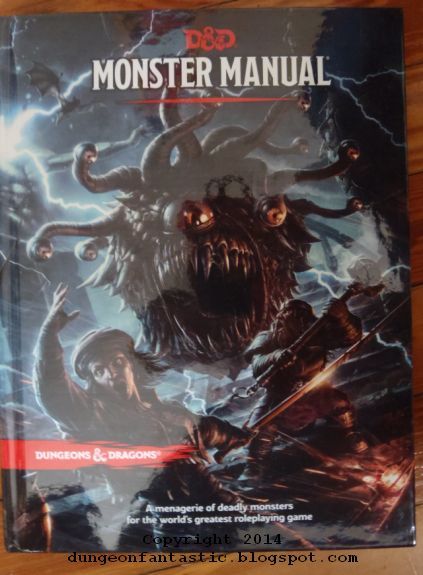
The 5e Monster Manual is here (+ BF Field Guide!)

I'll try to get a review up soon, but for now, the latest addition to my collection of monster manuals (for games I'm fluent in, anyway.)

Shiny! photo MonsterManual001s_zpsc4805f02.jpg


So far, it looks pretty cool. Of course I flipped right open to one of those monsters I just don't get the attraction in (the Chain Devil) but whatever. I'll be steadily reading this in my spare moments.


*Oops, spoke too soon. This is the latest addition, arriving just now:

Old-School-y! photo FieldGuide001s_zpsa96351b7.jpg
Related Posts Plugin for WordPress, Blogger...