Tuesday, August 5, 2014

Review: G1-3 Against the Giants
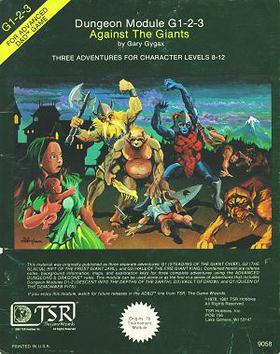
This was an easy request to fill - re-read and review the G-series of adventures. I'd been meaning to take a look at them, I'd had the original tournament writeup in mind, and then Roll For Initiative took a look at G1 in their 150th episode. So it seemed like something to get right on and do immediately.

G1-3 Against the Giants

by Gary Gygax
32 pages

aka:
G1 Steading of the Hill Giant Chief
G2 Glacial Rift of the Frost Giant Jarl
G3 Hall of the Fire Giant King


Here is my collection of these, including some destroyed scraps:


These adventures originated as tournament adventures, for a three-round tournament. If you want to know how the adventure and its two sequels played at least for some groups, and have access to early issues or the Dragon Magazine Archive, you can find out. It's in The Dragon #19, p. 3-4 and 6-7.

The compilation G1-3 has what I gather are the nine original tournament PCs. Their levels and gear match the playtest report in The Dragon #19. They range from 9th (also a 5/8 F/M-U) to 14th level (a fighter with 104 HP and -5 AC) and are pretty well equipped, especially with healing potions and dust of disappearance. Stats are high - most have at least one 18, and the guy with only two 16s has 55 HP as a 12th level M-U (just short of max.) Naturally, there is also a dwarf with a +3 Dwarven Hammer and a Ring of Invisibility. Yowza. They're pretty serious adventurers. They do have some ridiculous names, though, like Fonkin Hoddypeak - which Gary Gygax would use as mild insults/terms of endearment in Saga of Old City.

G1 The Steading Of The Hill Giant Chief

G1 gets the series rolling, with the PCs tasked to punish some raiding giants who have seemed all too organized for hill giants, and to discover or what is the force behind them. There is no wilderness component - game start is right in front of the steading of hill giant chief. The PCs arrive just in time for a big to-do, so the guards they've been warned about aren't at the front door. It's set up with a "or else" by the nobles who sent the party that is much mocked online, but it always felt right to me - you're on a serious mission backed by equally serious folks.

The whole adventure is all of 8 pages with maps on the inside of the cover. But it packs a lot into those 8 pages. You get a giant's conference, a slave revolt, oppressed cave-dwellers, some hidden locations with bizarre things the giants and revolting slave orcs equally want nothing to do with, and plenty of action. There are all sorts of chances to use the environment for or against the PCs, and many sections where clever play can turn encounters into sources of information or even fight-ending moves. The adventure nicely deals with the possibility of "let's burn the place down!" and what will follow if the PCs do that, too, leaving little work for the GM to pick up after the fire and get things rolling.

Despite all of that, the adventure is largely hack-and-slash. A moderately thorough party that generally solves problems with direct combat, searches relatively well, and doesn't burn down obvious sources of intelligence (scrolls, maps, etc.) will be fine. It's no S1 Tomb of Horrors or S2 White Plume Mountain. Straight combat is the vast majority of the adventure. Good and interesting combat, but you can solve this one with swords and fireballs. The adventure pretty much rewards a mild sneak followed by extreme violence. The more alert foes in the later modules, though, punish that approach enough that you'd better get sneakier as you go and search a lot more thoroughly. While there are a couple of especially interesting areas, they aren't must-solve puzzles - and mostly fall into the "better off left alone" Gygaxian save-or-die type.

It's a complete adventure - almost nothing is left for the GM to determine at the last minute. It's done in the very old style of monster stat lines being nothing but HP, and the occasional "Fights as a frost giant" line. Which really does require a little extra prep by the GM, who not only needs to look up the HD, AC, etc. of hill giants and their various allies and slaves, but then to look up the HD of other monsters not in the adventure to cover the guys who "fight as a." It makes me pine for THAC0 when it showed up later in 1st edition AD&D modules. From experience, I can also tell you that for all three of these modules, you'll be much better off if you make a roster sheet, especially if the PCs raid, rest, and then return. The statlines from the back of the DMG are invaluable here.

It's got a lot of treasure, if you can either find the main stashes or wholly clear the place out. They include some Easter egg-like ones (like a giant slaying sword owned by one of the giant's guests . . . in case of treachery, perhaps). But you'll have to work for it. Not only that, but considering the level of the PCs - level 8-12, and the optimal mix suggested is 9 PCs of level 9 average. At those levels, a big pile of gold divided nine ways isn't going to be a major impact, and might just be needed to push PCs up levels as they go through the series. When your fighter needs 250,000 xp to level up, and the mage 375,000 xp, all the treasure they can carry away at 10 coins to the pound isn't going to amount to much.

G2 Glacial Rift of the Frost Giant Jarl

This one is also 8 pages, with maps on the inside of the cover. It details the multi-level rift of the frost giants and its inhabitants.

Hands-down, my favorite. Icy winds, fog if you throw fireballs (which is either good or bad, depending on the situation), slick floors, and lots of tough giants. It feels lived-in and it's tough. And it has two dragons in it, together. Plus hidden places with more loot and challenges, some required careful searching to even accomplish the first part of your goal - decapitating the giant's leadership - nevermind the second - finding out who is backing these giants. Again, lots of loot, but lots of really tough foes.

Like G1, there are a lot of little hooks here. There are odd bits - some frozen corpses set up to frighten intruders, but they're off to the side in a place easily bypassed. Against, it's hack-and-slash, although you need more searching to complete the adventure. There aren't any clever tricks or cunning traps, it's straightforward PCs vs. the monsters & the environment. And while slipping and creating fog with fireballs is covered, the module (in retrospect, surprisingly) doesn't discuss the cold. I never ran it with any concern for the PCs bundling up, which seems odd. I couldn't tell you off-hand if AD&D had any cold weather rules, but this would have been a good place for some chilling weather that slowly sapped away your ability to fight and limited your ability to rest and recover.

G3 Hall of the Fire Giant King

The finale of the series is 16 pages, with maps inside the cover fold.

This one is pretty amazing. Just about the toughest evil giants you can expect to encounter in groups - fire giants - and lots of allies. Ettins, gnolls, trolls, hell hounds, and pretty much every thematically fire-related monster. Plus - spoiler alert - it was the first appearance of the drow.

Like G1 and G2, there are hidden areas, places you can mess up and hurt yourself to no good purpose, and fights to avoid. There are places with things you should just not touch. There are potential allies here, too, mixed in with pretend allies. There are nasty set-piece fights and plenty of places for the giants to fight, retreat, and rally. Their clever allies means that the GM can really cut loose on the PCs even more than in G1 and G2, where the smartest guys in the room aren't that smart. It's a very difficult challenge for underequipped or tactically unsound PCs.

Like G1 and G2, it's complete and ready to go . . . mostly. Some treasure is underdetailed - scrolls and potions you need to roll up yourself, gems and jewelry you need to do the same for, and some magic items lacking important details (a sword you need to roll up, one suit of magic armor that doesn't even say what kind of armor it is.) Space must have been a concern, but you need to comb through and find and generate those ahead of time if you don't want to waste time at the table.

Overall

These are classics for a reason. Hard hack-and-slash with a purpose and a mission, high level play (like I said, one tournament PC was 14th level), and a lot of hooks and detail-inspiring wording throughout. They're complete and ready to go with minimal prep (except for those annoying "scroll of 7 sevens (determine randomly)" kind of treasure placements, mostly in G3.

The differences between G1-3 and G1, G2, and G3 are mostly art and some line spacings and such being tightened up so 32 pages could fit into 32 pages once one was dedicated to the tournament PCs.

These are amongst the best adventures Gary Gygax wrote, in my opinion. They cram a lot into a small wordcount and they're easy to drop in to a campaign.

I especially like the GM advice.

"There is considerable information contained herein which is descriptive and informative with respect to what the players see and do. Note that this does not mean that you, as Dungeon Master, must surrender your creatively and become a mere script reader. You must supply considerable amounts of additional material. You will have to make up certain details of areas. There will be actions which are not allowed for here, and you will have to judge whether or not you will permit them. Finally, you can amend and alter monsters and treasures as you see fit, hopefully within the parameters of this module, and with an eye towards the whole, but to suit your particular players."

That would be a great forward to any adventure, and should show up in your basic advice to new GMs. Hopefully a little more directly and clearly. Gary Gygax was amazing, but sometimes he pulled Vancian prose into what should have been technical writing. You can cut that down to something akin to "There is a lot of information here about what the PCs see and do. That doesn't mean the DM is a mere script writer - you can, will, and must supply considerable amounts of additional details. You will have to make up details, allow (or deny) actions not allowed for in the adventure, and otherwise referee the game as you see fit. Finally, feel free to change any monsters or treasures to fit your game." Something like that. But even unchanged, yes, that's extremely good advice on how to GM.

Good stuff, these adventures. If you don't have them and you're running AD&D or something close to it, I'd find them and play them.


Tomorrow I'll post some war stories, to avoid sticking spoilers in this review beyond what I've done so far.

If you like this review, you might like the consolidated Reviews page.

Monday, August 4, 2014

What to do with captured PCs

Over on The Lands of Nandame I wrote some comments about what to do with captured PCs.

I wrote a whole article about this back in the Pyramid 2.0 days, called "Digging Yourself Out of a Corner." It's lost to wherever Pyramid 2.0 articles are now.

My advice is simple at its core. Make sure the players know this is the progression of outcomes, in terms of best to worst.

1) Victory
2) Capture
3) Death

If Capture is actually worse than death, the PCs will always try to fight it out until they die. Why play dead, surrender, negotiate, etc. when doing so is always worse than trying to pull victory out of the jaws of death? So make sure it's better than death even if it's worse than victory.

It's okay if the NPCs describe capture as a fate worse than death, and it can be miserable for the characters, but it must be fun for the PCs. Make them groan, wish they'd won, but have a war story to tell that doesn't end with "and then we all died and made up new guys." True story - I had PCs captured by slavers, once, after a disastrously handled combat. Basically more half the group decided to quit the game. Two guys wanted to keep playing. I had them sold as slave-soldiers; this suited one PC and made the other miserable . . . but it suited both players. So it worked out well, and we played "slave-soldiers" for a while until they eventually escaped. The alternative would have been to start over with new PCs.

In short, make capture interesting.

One bit I especially liked in Vornheim was the advice to make the legal system more interesting. To quote myself - "One piece I especially liked was that adventures in town generally mean breaking the law, so the law has to further the adventure not bring the game to a screeching halt."

Capture and legal consequences go hand in hand - having the cops grab you and punish you for your crimes is just a specific case of capture.

So what can you do with captured guys?

First off, no matter what the NPCs said - "Kill them all! No prisoners!" or "Take them to be eaten by the bugblatter beast!" or whatever - don't kill them all. If you do that, #2 is as bad as #3.

Next, you don't have to take all of their stuff. Players hate this intensely, in my experience. At least consider letting the NPCs give some or all of it back, or ransom it back to them, or sell it to someone the PCs can retrieve it from.

What you need to do next is figure out what the NPCs want.

What do the NPCs want?

Figure out what they want more than some PC corpses on hand.

Money? They can ransom the PCs for more than they are carrying. If the PCs need to borrow the money, let them - and if they borrow it from another NPC who they'll need to pay back with adventurous quests, all the better.

Sacrifices? Have the captors send the PCs off on a quest for sacrifices.

A quest object? Maybe they need something done that's very dangerous, maybe certainly fatal, and the PCs can be sent to do it.

Information? Maybe the PCs can spill the beans on something, and that's so valuable the NPCs will let them go.

Help? Remember Angel Eyes and Blondie? Blondie is a captive, but his captor wanted his help.

Amusement? Maybe they want you to be their team in the annual bloodsport tournament, or to see if their death traps work, or to otherwise do something that's funnier when it's not you . . . and it's often easier to escape when this is going on.

Remember, the NPCs needn't be bloodthirsty, and equally they needn't be happy with the tradeoff - it only matters if it makes some sense to them and it propels the game forward.

Clever NPCs might want to, if they basically let the PCs go in exchange for stuff, ask for a no-retaliation promise. Maybe they heard the story of Julius Ceaser and the pirates, and figure, why let them go if they'll just turn around and rob you back for the ransom? This can make the world more interesting, as the PCs will have NPCs they resent but promised not to attack.

Don't forget third party intervention

There is always someone out there who wants what the PCs have, or can do. The captors might have no use for the PCs, but they might need something that NPC has. The PCs can be bargaining chips and traded for something they don't even have.

"Sold as slave gladiators" is this, in a nutshell. The captors want money, the buyers want tough fighters, and the PCs want to not be dead.

A mysterious NPC is great here - the bandits have you, but now some mysterious wizard comes and buys you off of them, because they want money and he needs something done.

Divine intervention is a bit over the top, but hey, what if the bad guys do sacrifice you to their demon-god, and then the demon-god says, "Great, thank me you're finally here! I have a job for you, and then I'll restore you to life."

Also, think of any 3-way sports deal - I want player C, but you don't want player A. So I trade player A for player B on some other team, and then trade player A to you for player C, and all three teams got something they wanted. A multi-group shuffle of trades can make the whole being captured thing a way to find out about other groups. The orcs capture you, and trade you to the hobgoblins for money, who trade you to the bandits for weapons, who trade you to the merchant's guild in return for their bandit prisoners . . . and the guildmaster has this, uhm, private manner he needs help with, and you owe him.

Hey, they got away!

And yes, you can just have the PCs have a chance to escape. That works, especially if they get aided by the beautiful daughter of the bad guy, like in any pulp novel.


Long story short? When the PCs surrender or get captured, make it a springboard to new and better adventure. It's okay if it costs them more than victory, it should. But don't make it so bad the game ends just as if it was a TPK. Capture should always be preferable to

Arms & Armor at the Met

I finally got to spend some time in the Arms and Armor exhibit at the Metropolitan Museum of Art in NYC yesterday.

I've been the museum before, but it was always with folks or with time limits that made it impossible to linger on the arms and armor section.


Some things I noted:

- the swords, at least the medieval/late medieval ones, ranged from 2 lbs 2 oz up to 3+ pounds for one handers, 3 pounds 7 ounces all the way to 6 pounds+ for hand-and-a-half swords and greatswords. Since GURPS Basic Set pegs swords at 3 pounds (broadsword), 5 pounds (bastard sword), and 7 pounds (greatsword), and since GURPS Low-Tech confirms this is roughly 2/3 sword and 1/3 sheath and furniture, the swords made the Basic Set seem pretty reasonable. RAW GURPS puts that swords sans sheaths at 2, 3.3, and 4.6 pounds, which compared the ones there were a little light, about right, and a little light. I'm sure larger collections would provide a much better same size, but still.

This one made the basic set seem generous.


It still makes Swords & Wizardry and 1st edition AD&D incredibly harsh though.

- The biggest greatsword, which I immediately though of Vryce wielding, was over 6 lbs. and had a handle in excess of 12". One of the hand-and-a-half swords - which weight in close to 4 pounds - would have come up to my armpit with the tip on the floor. That's hockey stick height for street hockey.

- they had a nice selection of Japanese war arrows, including narrow-tipped ones for armor pieces and wide cutting heads, too. They also have ceremonial arrows for display, which are exquisite but were about as useful in combat as the Faberge eggs they have up on the third floor.

- generally, maces and axes are generally much smaller than you'd probably expect, especially if you come at them from the fantasy art angle. Sadly they didn't put weights on them.

- the polearms they have are mostly later and ceremonial, but still cool. Funniest thing I heard while looking at them? "Did they use them for jousting?" "It doesn't say. I think so." Yeah, the standard jousting halberd is pretty awesome.

- they have a nice rapier selection. Early rapiers, especially, look like they'd cut extremely well for all that they are designed for stabbing in the main. The smallswords really go the other way - smaller, shorter, and stiff and edgeless. Generally, though, looking at the swords classified as rapiers, the whole "I'd stab him through the chinks in his plate armor with my needle-like rapier" thing seems silly, especially seeing how tiny actual eye slits are.

- armor is lighter than most early RPGs (GURPS included) makes it. Helmets, though, are pretty hefty. One was in excess of 10 pounds. Nicely, most of the suits list weights to the ounce or gram.

- they have a lot of horse armor, including my favorite stuff - spiked bridles and chain reins for horses. No screwing around with "I grab the horse's gear and make him throw the rider!" when it's covered in spikes.


All it all, it was nice to finally get to see what they have on display. I've seen collections before, but not so much, so close, and labeled in English along with weights. I'd love to see more. I've seen a lot of swords in Japan (including the official sword museum) so I didn't spend much time on the swords they have . . . although they have a very early to and some swords either imported from or copied from China . . . and an early Japanese sword that wasn't cut down later as shorter swords came into vogue. I also managed to find lots of Japanese weapons from the Boshin War on display in Japan. But the European stuff I find fascinating yet hard to actually get up close with.

Sunday, August 3, 2014

DF Felltower: Where are the summaries?

I haven't posted a summary in a couple weeks, and it'll be longer before I do.

What's up?

Basically, it's Summer, and I'm busy and on the days I'm not, many if not most of the gaming group is also busy. That means we're taking a month between sessions. The next game should be in 2 weeks.

But that's not all. We're also taking a short side trip from our DF game.

We've been discussing running Gamma World for a while. One of my players, andi jones, who runs the Black Ray Gun tumblr, is a huge Gamma World fan. As am I.

We'd both discussed running GW for the group this summer.

So, naturally, we had to sort out who would GM.

I sent out an email listing a few ways to run GW:

- unfrozen 21st century super-soldiers - inspired by the Morrow Project for the other GM, by my old GURPS Mutants & Mayhem game (run for the players of Vryce, Dryst, and Honus, plus later two others) for me.

- DF guys transported mysteriously to a post-apocalypse setting - Inspired by Faceless Men & Clockwork Monsters and the utter ease of mixing tech and magic in a universal game system like GURPS. This wouldn't mix with our current group, but we'd assume the PCs came from the same world Felltower is on for consistency of rulings.

- primitive post-apocalypse tribesmen - inspired by the original setup of Gamma World.

The players chose the first. The other GM and I had discussed this privately - if they chose that option, he'd run the game and I'd play. If they chose the other options, I'd GM and he'd play.

So since they chose the first, I'll hopefully be playing instead of GMing in a couple weeks, on a day we'd normally spend delving into Felltower.

With any luck, it'll stick, and we can share the world - or at least the concepts - and I can also run games in it. We'll see how it all works out. I'm looking forward to playing but I'm a little jealous, too - there is little I love more than springing post-apocalyptic horrors from Gamma World on people and seeing what they make of it. Soon it will be my turn!

Saturday, August 2, 2014

Glosscote Rescue: Partial Success

I tried the other day to rescue my frosted minis with a coat of Glosscote.

Here is what I got:

 photo FuzzyMinis001_zps6eecd3a4.jpg

 photo FuzzyMinis002_zps09d00f30.jpg

 photo FuzzyMinis003_zps41cd4911.jpg

 photo FuzzyMinis004_zpsca3f2172.jpg


One side of the minis is quite good. The other, still frosted and grainy. I think I got a more consistent coat on one side. So clearly it's working, but I need another coat, and a more consistent coat on the opposite side of those minis.

Next time the humidity drops below 50% and the heat to 70 or less, I'll try again to re-seal them.

Friday, August 1, 2014

My first RPG

I saw a few guys I like do this on Google+, so why not?

I've posted about this before, but here it is again.

My first RPG was back in 1981. To keep it short, I'd seen my uncle's D&D books and I was fascinated by them. I convinced my mom to get me the D&D Basic Set for Christmas.

A couple of kids of a person she knew played the game, so they got to babysit me one morning and run me through B1 The Keep on the Borderlands. The older brother originally wanted to run me through his own adventure, but his mom told him to show me how to play with the game I brought - for which I'm eternally grateful.

My elf, Goldleaf, and the DM's brother went up to the gnoll caves and inside. I'd read the module but couldn't figure out how to match the maps to the text key. We fought some gnolls, ran from more, and eventually ended up in the chief's room. There we blocked the door behind us and killed the chief.

After that, we found our way to the wight, shot him up with some silver arrows to no avail, and then ran.

I made it back, the DM showed me how to read the map key and match it to the text, and I was off.

Those guys also owned the DMG (which I was fascinated by) and the Fiend Folio, which mesmerized me to the point that I bought it as soon as I could - before the Monster Manual, even.

I owe my first misunderstandings of D&D to those guys, too. They played AD&D, and converted me on the spot from a D&D Basic Elf to a F/M-U/T, and had me roll for spells known. They told me I could cast each one once at 1st level, and I did. They also let me keep my HP roll from being an elf, which led to a total and systematic misunderstanding by me about how multi-class HP worked, too.

But all in all, they taught me to play. I'd later play in my uncle's game, too - same guy I gave the PHB back to not all that long ago.

And naturally, I incorporated this experience into my current DF game!

I have my marching orders

The modules people asked for reviews on:

A1 - A4 - the slavers series
G1-3 Against the Giants
D1-2 Descent into the Depths of the Earth
WG4 Forgotten Temple of Tharizdun
L1 The Secret of Bone Hill
The C-series modules
The rest of the S-series modules (here is S2)

I'll try to prioritize those in my reviews and look-backs over my gaming materials. I might take a detour into the UK and U series, which had a tremendous effect on my gaming, but I'll try to get to the requests as early as I can.
Related Posts Plugin for WordPress, Blogger...