Bookmarking these for my own use, and possibly yours:
DragonDex - Dragon Article List by Author
DragonDex - Fiction in Dragon by Author
Showing posts with label Dragon. Show all posts
Showing posts with label Dragon. Show all posts
Monday, December 23, 2024


Friday, November 27, 2020
Friday Links 10/27/2020
This will be short today, as I've been having some computer issues and chose to solve them tonight . . . so I have no time to post. I'd blamed Windows 10 except it's working fine on 2 of my 3 machines, and badly on another.*
- These Japanese B/X D&D covers are really very Japanese and very anime. I don't think I've seen them before, or shared them if I had. It strongly resembles that Wizardry anime, ne?
- Dragon body parts as loot. Way ahead of you there, although even I was late compared to the first . . . I recall people coveting dragon-scale armor back in my elementary school AD&D days.
- I passed on every single sale this year for Black Friday. The only thing I was eyeing was Fire in the Lake and the two places I was looking, the price went UP on Black Friday. Nevermind.
* Basically, explorer.exe keeps crashing, it locks up when I click on "Open With," it frequently goes extremely slowly, and icons and images show blank very frequently. Even a full system reset was to no avail. It reset fine, and then within 45 minutes of that, while I was slowly trying to build my apps back out, it started again. I'm trying System Restore now but I do not hold out any hope as I suspect an update is clashing with something else on my system, and I can't tell which one. Suggestions on fixes are welcome but I may have tried it already, as I tried everything I could find at least twice each before going for a soul-destroying "reset."
- These Japanese B/X D&D covers are really very Japanese and very anime. I don't think I've seen them before, or shared them if I had. It strongly resembles that Wizardry anime, ne?
- Dragon body parts as loot. Way ahead of you there, although even I was late compared to the first . . . I recall people coveting dragon-scale armor back in my elementary school AD&D days.
- I passed on every single sale this year for Black Friday. The only thing I was eyeing was Fire in the Lake and the two places I was looking, the price went UP on Black Friday. Nevermind.
* Basically, explorer.exe keeps crashing, it locks up when I click on "Open With," it frequently goes extremely slowly, and icons and images show blank very frequently. Even a full system reset was to no avail. It reset fine, and then within 45 minutes of that, while I was slowly trying to build my apps back out, it started again. I'm trying System Restore now but I do not hold out any hope as I suspect an update is clashing with something else on my system, and I can't tell which one. Suggestions on fixes are welcome but I may have tried it already, as I tried everything I could find at least twice each before going for a soul-destroying "reset."
Wednesday, July 29, 2020
Plan It By the Numbers - Frank Mentzer & setting encounters in D&D
In Gary Gygax's article "FIRST ADVENTURES IN DUNGEONEERING (by Gary Gygax, USA)," discussed here yesterday, I made this comment in the comments section:
"It's true, but the core idea for me is that you have a chance - to win by fighting, to win by outwitting, to evade by running. Since your options on all three are really level dependent, ultimately, it's really saying that balanced decisions about appropriate encounters are part of the basic job of the GM. It's not a numeric system like you'd find later for BECMI D&D, but it's still help up as a basic element of dungeon design. It's still on the continuum of balancing risk and reward and capabilities of the PCs that ends in scaled encountered."
Wait, what? BECMI had a system for balancing encounters?
Yes.
Dragon #101 had an article by Frank Mentzer, author of the Basic, Expert, Companion, Master and Immortals D&D rules - the BECMI system.

Plan it by the numbers
A system for tailoring challenges to characters
by Frank Mentzer
It includes this:
"Author’s note: The following was in-
cluded in the original manuscript for the
D&D® Master Set. It was, however,
thought by the editors to be too heavily
mathematic for easy use, and was replaced
by an alternate system. But I still like this
one, and use it in my own campaign —
though modified for AD&D® game use.)"
What followed is a mathematical system for balancing encounters for PCs.
The system took the Average Party Level and Total Party level into account, along with a % of that - from up to 20% of TPL (for an easy wandering encounter) to over 200% of TPL (extreme danger, run or die). You could/should also compare to the Average Party Level, with the same relative strength (from nuisance encounter - amusingly, the same term I use for such in my own games - to "extremely dangerous opponent."
You'd use the HD, HP, us a multiple based on the "Power Index" (number of *s next to their HD) to determine a numerical value, compare, and go from there.
Take these examples (column width not adjusted - this is just cut-and-paste):
"A. Low Level Party; size = 5, TPL 26,
APL 5.2
Situation #1: Wandering encounter
1. Impact desired: Average opponent,
average encounter.
2. HD of one monster: 90-1 10% APL, or
90% of 5.2 to 110% of 5.2, or 4.7 to
5.7. Average = 5.2; monster chosen:
cockatrice (HD 5**).
3. Power Factor: 2 (asterisks).
4. Total monster HD: 30-50% TPL, or
30% of 26 to 50% of 26, or 7.8 to 13.
5. Number appearing: 7.8/5 to 13/5, or
1.56 to 2.6, each divided by 2 (PF) =
0.78 to 1.3. One cockatrice wanders
by.
6. Convert decimals: Average hp = 22.5,
multiplied by 0.78 and 1.3. The cocka-
trice has 18-29 hp."
Or maybe your guys are higher level?
"C. High-level party; size = 4, TPL 132,
APL 34
Situation #1: Wandering encounter
1. Impact desired: Easy opponent, Minor
encounter.
2. HD of one monster: 30-50% APL, or
10.2 to 17, average = 13.6. Monster
chosen: cloud giant (HD 13*).
3. Power Factor: 1 (may be ignored).
4. Total monster HD: 20-30% TPL, or
26.4 to 39.6.
5. Number appearing: 26.4/13 to 39.6/
13, or 2.03 to 3.04; 2-3 giants wander
by.
6. Convert decimals: Average hp = 58.5;
the 2-3 cloud giants have a total of
119-178 hp (each with 13-104 hp)."
So you want a minor hazard for your 4 PCs who average 34th level and total 132 levels (actually 132/4 = 33rd average level) - turns out 2-3 cloud giants will do, mathematically. #2 is "minor placed encounter" with a potentially 160 HP red dragon. You know you've hit the big time when math says dragons are minor fights.
It also has advice on using this on the fly to make an encounter match the PCs better on the fly - instead of changing die rolls, change the monsters. "I make up results regularly, to keep the game fun - and isn't that why we're all playing?"
I always think of that when I hear gripes about "balanced encounters." Making all of this a mathematical thing happened in print as early as September 1985. That's even before I stopped playing AD&D and moved fully on to Rolemaster and GURPS (and then just GURPS.) It's a workable system, too, if more mathematically heavy than other systems I've seen for balance. If you play a D&D-based system, by which I mean BECMI or B/X, this system works very smoothly. It might be worth a look if you can find Dragon #101.*
* I bought that Dragon Archive back in the day so I'm lucky, there.
"It's true, but the core idea for me is that you have a chance - to win by fighting, to win by outwitting, to evade by running. Since your options on all three are really level dependent, ultimately, it's really saying that balanced decisions about appropriate encounters are part of the basic job of the GM. It's not a numeric system like you'd find later for BECMI D&D, but it's still help up as a basic element of dungeon design. It's still on the continuum of balancing risk and reward and capabilities of the PCs that ends in scaled encountered."
Wait, what? BECMI had a system for balancing encounters?
Yes.
Dragon #101 had an article by Frank Mentzer, author of the Basic, Expert, Companion, Master and Immortals D&D rules - the BECMI system.

Plan it by the numbers
A system for tailoring challenges to characters
by Frank Mentzer
It includes this:
"Author’s note: The following was in-
cluded in the original manuscript for the
D&D® Master Set. It was, however,
thought by the editors to be too heavily
mathematic for easy use, and was replaced
by an alternate system. But I still like this
one, and use it in my own campaign —
though modified for AD&D® game use.)"
What followed is a mathematical system for balancing encounters for PCs.
The system took the Average Party Level and Total Party level into account, along with a % of that - from up to 20% of TPL (for an easy wandering encounter) to over 200% of TPL (extreme danger, run or die). You could/should also compare to the Average Party Level, with the same relative strength (from nuisance encounter - amusingly, the same term I use for such in my own games - to "extremely dangerous opponent."
You'd use the HD, HP, us a multiple based on the "Power Index" (number of *s next to their HD) to determine a numerical value, compare, and go from there.
Take these examples (column width not adjusted - this is just cut-and-paste):
"A. Low Level Party; size = 5, TPL 26,
APL 5.2
Situation #1: Wandering encounter
1. Impact desired: Average opponent,
average encounter.
2. HD of one monster: 90-1 10% APL, or
90% of 5.2 to 110% of 5.2, or 4.7 to
5.7. Average = 5.2; monster chosen:
cockatrice (HD 5**).
3. Power Factor: 2 (asterisks).
4. Total monster HD: 30-50% TPL, or
30% of 26 to 50% of 26, or 7.8 to 13.
5. Number appearing: 7.8/5 to 13/5, or
1.56 to 2.6, each divided by 2 (PF) =
0.78 to 1.3. One cockatrice wanders
by.
6. Convert decimals: Average hp = 22.5,
multiplied by 0.78 and 1.3. The cocka-
trice has 18-29 hp."
Or maybe your guys are higher level?
"C. High-level party; size = 4, TPL 132,
APL 34
Situation #1: Wandering encounter
1. Impact desired: Easy opponent, Minor
encounter.
2. HD of one monster: 30-50% APL, or
10.2 to 17, average = 13.6. Monster
chosen: cloud giant (HD 13*).
3. Power Factor: 1 (may be ignored).
4. Total monster HD: 20-30% TPL, or
26.4 to 39.6.
5. Number appearing: 26.4/13 to 39.6/
13, or 2.03 to 3.04; 2-3 giants wander
by.
6. Convert decimals: Average hp = 58.5;
the 2-3 cloud giants have a total of
119-178 hp (each with 13-104 hp)."
So you want a minor hazard for your 4 PCs who average 34th level and total 132 levels (actually 132/4 = 33rd average level) - turns out 2-3 cloud giants will do, mathematically. #2 is "minor placed encounter" with a potentially 160 HP red dragon. You know you've hit the big time when math says dragons are minor fights.
It also has advice on using this on the fly to make an encounter match the PCs better on the fly - instead of changing die rolls, change the monsters. "I make up results regularly, to keep the game fun - and isn't that why we're all playing?"
I always think of that when I hear gripes about "balanced encounters." Making all of this a mathematical thing happened in print as early as September 1985. That's even before I stopped playing AD&D and moved fully on to Rolemaster and GURPS (and then just GURPS.) It's a workable system, too, if more mathematically heavy than other systems I've seen for balance. If you play a D&D-based system, by which I mean BECMI or B/X, this system works very smoothly. It might be worth a look if you can find Dragon #101.*
* I bought that Dragon Archive back in the day so I'm lucky, there.
Wednesday, August 21, 2019
Selling Dragons - did it come up in your game?
One thing from AD&D that we never had happen - not once - was selling a dragon.
We didn't have people fight to subdue, either, which is probably the primary cause of not having dragons to sell.
But overall, it's one of those things I found odd. There isn't much of an economy for monsters. A few - mostly ones that can be trained as mounts - have valuable eggs or young. But you don't have a sale value for orc slaves, owlbears you trapped in a cage, that roper you charmed, etc.
But dragons have a standard market value - and it's not even that terribly high. 1d8 x 100 gp per HP. That huge, ancient red dragon that seems to come up in every campaign somewhere is worth a whopping 88 x 100-800 gp or 8800 gp to 70,400 gp. Not low, really, with an average of 39,600. But how high is that when the average gp value of its monetary hoard is a bit above 80,000?
Potentially it's a way to increase the value by 50%. Or realize profits when you catch the dragon out of its lair and can't find it or get to it.
Yet I've never seen it done. I've read about it in Gary Gygax's columns in Dragon magazine, and in the AD&D books, but never seen it done in play.
Just another element AD&D spent a lot of time on that just didn't impact my gaming.
We didn't have people fight to subdue, either, which is probably the primary cause of not having dragons to sell.
But overall, it's one of those things I found odd. There isn't much of an economy for monsters. A few - mostly ones that can be trained as mounts - have valuable eggs or young. But you don't have a sale value for orc slaves, owlbears you trapped in a cage, that roper you charmed, etc.
But dragons have a standard market value - and it's not even that terribly high. 1d8 x 100 gp per HP. That huge, ancient red dragon that seems to come up in every campaign somewhere is worth a whopping 88 x 100-800 gp or 8800 gp to 70,400 gp. Not low, really, with an average of 39,600. But how high is that when the average gp value of its monetary hoard is a bit above 80,000?
Potentially it's a way to increase the value by 50%. Or realize profits when you catch the dragon out of its lair and can't find it or get to it.
Yet I've never seen it done. I've read about it in Gary Gygax's columns in Dragon magazine, and in the AD&D books, but never seen it done in play.
Just another element AD&D spent a lot of time on that just didn't impact my gaming.
Sunday, December 9, 2018
Felltower status
We're going to play one more game in Felltower on 12/30, to end out the old year with one of three probable outcomes:
- a partial TPK
- a dead dragon
- or both!
Me, I'm hoping forboth a successful and fun delve.
One thing about such a delve, though, is that the PCs still don't entirely know how to handle dragons.
They've heard about needing dragon-slaying swords, or an arrow to a vulnerable spot (but not just any arrow, one particular arrow) but don't know if that's true.
They've heard you can capture dragons and sell them . . . but don't know if that is true.
They do know that a plethora of spells seem useful against dragons:
Resist Poison
Resist Fire
Resist Acid
Shield
Armor
Walk on Air
Flight
and more.
They are stockpiling spellstones with such spells, plus healing, plus mundane tools to carve up a dead dragon, plus potions, plus anything else they can think of.
They've making their lists and checking them twice, as the season requires.
Me, I've long ago made up that dragon . . . and I can't wait to see how it all turns out.
- a partial TPK
- a dead dragon
- or both!
Me, I'm hoping for
One thing about such a delve, though, is that the PCs still don't entirely know how to handle dragons.
They've heard about needing dragon-slaying swords, or an arrow to a vulnerable spot (but not just any arrow, one particular arrow) but don't know if that's true.
They've heard you can capture dragons and sell them . . . but don't know if that is true.
They do know that a plethora of spells seem useful against dragons:
Resist Poison
Resist Fire
Resist Acid
Shield
Armor
Walk on Air
Flight
and more.
They are stockpiling spellstones with such spells, plus healing, plus mundane tools to carve up a dead dragon, plus potions, plus anything else they can think of.
They've making their lists and checking them twice, as the season requires.
Me, I've long ago made up that dragon . . . and I can't wait to see how it all turns out.
Saturday, October 18, 2014
Review: A1 Slave Pits of the Undercity
I finally had some time to get back to reviews. Recently the A-series of modules came up in a discussion about capturing PCs by fiat. So I re-read that quickly and then decided to get right onto reviewing the whole series. Unlike the Giants series, these are long - the entire G1-3 is not much bigger than A1, so I will do each A-series module in turn.
I also have - and ran - A1-4 Scourge of the Slavelords. However, although it includes modules 1-4, it also changes substantially how you approach those adventures and fills in things in between. Since they are fairly big changes, I decided I should deal with that supermodule in its own post.

A1 Slave Pits of the Undercity
by David Cook
Levels 4-7
24 pages plus maps inside the cover
TSR 9039
A1 is the first of a four-part series of tournament adventures. According to the module, the original tournament was split into two rounds:
- One round of exploring the upper works, and discovering the way into the sewers.
- One round of exploring the sewers, and eliminating the boss slaver and finding the clues that lead to A2 The Secret of the Slavers Stockcade.
The released adventure is much larger, with an expanded upper works and a much-expanded sewer level with multiple connections up and down between them.
The setup for the adventure is simple - the disorganized lords along the coast have long tolerated the raids of yellow-sailed slave ships, or bribed their way out of them. Recently, the slavers have grown more bold and aggressive and burned villages and ignored agreements. Instead of sending a fleet, they decide to send a few parties of adventurers [tournament setup, right there] to try to infiltrate as potential slave buyers and backtrack the slaver's bosses.
The PCs show up at the ruined city of Highport, set in the Pomarj of Greyhawk. The city is inhabited by humanoids and half-humanoids, and visited regularly by slave traders and outsiders. So they can easily slip in and into the secret back door of the slaver's Highport headquarters, which was revealed by an escaped slave before they left on their mission. The lax guards don't really notice the intrusion.
The module puts a lot of effort into wandering monsters in the ruins, along the walls, etc. - none of which matter at all in tournament play. It only matters if you chose to run the game without the players getting secret inside knowledge to let them get into the place, or didn't allow them smoothly sailing through the ruins of Highport. If you follow the same setup for non-tournament play, the additional detail isn't worth very much. I did like that there is a "Wandering Monster Roster" - as you kill them off, you cross them off, and there is a limit to how many giant crocodiles or half-orc cleric/assassins you can just blunder into. As well, it's made clear that any human-led slave buyers you run into will simply try to deal with you, not fight you, as they aren't there for that at all.
The adventure overall is very good.
It's well written, although often fairly dense - no encounter is just a statline, and even empty rooms get some text and explanation. The box text is clear and doesn't commit the crime of telling you what you do or starting interactions - it's purely descriptive and covers what you can see, hear, and smell.
There are some clear instructions for what happens when PCs try interesting tactics, too, to disable traps, use noxious materials as weapons, and so on.
Not only that, the setting itself is pretty cool. The ruin is clear, and often the PCs are wading through water, dealing with burned-out rooms and timbers, plants grow down into tunnels, and so on. It's a creepy place that feels like an undermaintained sewer under a ruined building turned fortress. Everything in the adventure, including the choices of monsters, supports that. Some monsters are interesting choices (this adventure features dopplegangers at several points, for example) but all make sense. It doesn't feel like a random funhouse but rather like an active yet badly maintained slave pit.
Additionally, many of the fights are tough. Foes use cover, flanking, trickery, special weapons, weapon mixes, and sheer numbers to challenge you. That's even before you get to terrain and special monsters. Several of the fights are potentially overwhelming for even a fresh party but come well after you've had a chance to get worn down. None of it seems unfair, just hard. The tournament version, of course, cuts many of those out. In the tournament version, you get all of the set pieces but not as many foes to deal with. In non-tournament play, you'd almost want to err on the high side of levels and numbers to deal with all of the extras you simply can't avoid unless the GM makes some unreasonably PC-friendly decisions.
As I mentioned a few times, this was a tournament adventure, and expanded for publication. In the tournament, the fact that the upper works is one round means you can't really have half of it unlikely to get explored. As a result, the connection between the two halves of the upper works is simple - there is a small bit of underground passageway you can follow from one to the other. In non-tournament play, that small bit of passageway is expanded into a large encounter area with active and dangerous foes and a connection to the slave pits themselves. In other words, it's easily possible - and in fact, if resource expenditure is even a small concern - to avoid half of the upper works. This is both good and bad. The good is that it means the dungeon offers some real choice, and it's not purely linear. The bad is that generally half of the upper works is ignorable, is better ignored, and takes serious exploration to get to without much reward for doing so besides some assorted loot and hard fighting. As my war stories section will go into, no one did that exploration in my two sorties into this adventure.
The adventure also includes two new monsters (the Aspis, an insectoid race; and the Giant Sundew.) It also has the original tournament scoring, which interestingly placed a higher premium on rooms explored than PC survival. Better to clear the place with high casualties than the not clear it, which meets the mission description well. There are also nine tournament characters, ranging from 3rd/3rd level to 6th. They had great names, like "Ogre" the human fighter with 18(56) STR, Dread Delgath the magic-user, and Phanstern the illusionist.
The illustrations are all by Diesel LaForce, Jim Roslof, Bill Willingham, and especially by Jeff Dee - who did the cover and several excellent interior pieces as well.
War Stories
This module is special to me in that it's the only Slave Lords adventure I ever went on as a player. I ran a solo 6th or 7th-level Archer (from Best of Dragon Magazine III). I pretty much snuck in, went down the sewer levels, ran around fighting aspis for a while, and then fled the dungeon. It was fun, especially when I was pretty much lost and being chased. I never completed the adventure, but it didn't matter.
Years later I ran this on its own, as supposedly part of the A1-4 supermodule, but I used the setup from the original. My players went in the back way and right down to the sewer levels and cleared much of it out before a disastrous fight got them all captured or killed. The couple of players who decided to keep playing were okay with being slaves for a bit, and it lead to a whole different (and pretty amazing) side campaign. I do also remember running this for my Elementary School group, but nothing beyond that - I just have vivid memories of using some critical hit rules in an early setup fight for it. It's possible the campaign ended before they reached A1.
In neither case did half of the upper level ever matter. Something that was unavoidable and the whole point of the upper level in the tournament, by dint of the changes to the map, was actually hard to encounter. Like I said above, this is good and bad. I kind of feel bad about it, because you miss some awesome set-piece fights there and some trickery and nastiness - all of which, once defeated, makes for great adventuring stories. Bypassing them entirely, not so much. I don't think my players even knew they missed anything.
I like so much about this adventure's set-pieces - cool tricks to introduce reinforcements, use of cover, special weaponry, tricky battlefields, reinforcements, trickery (which is detectable if you play well), and special foes. I deliberately crafted a section of Felltower (the Flooded Prison) to use the sunken slave pits and fighting along the narrow tops of the cages in my current game.
Overall, a good adventure either as a whole or to plunder from.
If you like this review, you might like the consolidated Reviews page.
I also have - and ran - A1-4 Scourge of the Slavelords. However, although it includes modules 1-4, it also changes substantially how you approach those adventures and fills in things in between. Since they are fairly big changes, I decided I should deal with that supermodule in its own post.
A1 Slave Pits of the Undercity
by David Cook
Levels 4-7
24 pages plus maps inside the cover
TSR 9039
A1 is the first of a four-part series of tournament adventures. According to the module, the original tournament was split into two rounds:
- One round of exploring the upper works, and discovering the way into the sewers.
- One round of exploring the sewers, and eliminating the boss slaver and finding the clues that lead to A2 The Secret of the Slavers Stockcade.
The released adventure is much larger, with an expanded upper works and a much-expanded sewer level with multiple connections up and down between them.
The setup for the adventure is simple - the disorganized lords along the coast have long tolerated the raids of yellow-sailed slave ships, or bribed their way out of them. Recently, the slavers have grown more bold and aggressive and burned villages and ignored agreements. Instead of sending a fleet, they decide to send a few parties of adventurers [tournament setup, right there] to try to infiltrate as potential slave buyers and backtrack the slaver's bosses.
The PCs show up at the ruined city of Highport, set in the Pomarj of Greyhawk. The city is inhabited by humanoids and half-humanoids, and visited regularly by slave traders and outsiders. So they can easily slip in and into the secret back door of the slaver's Highport headquarters, which was revealed by an escaped slave before they left on their mission. The lax guards don't really notice the intrusion.
The module puts a lot of effort into wandering monsters in the ruins, along the walls, etc. - none of which matter at all in tournament play. It only matters if you chose to run the game without the players getting secret inside knowledge to let them get into the place, or didn't allow them smoothly sailing through the ruins of Highport. If you follow the same setup for non-tournament play, the additional detail isn't worth very much. I did like that there is a "Wandering Monster Roster" - as you kill them off, you cross them off, and there is a limit to how many giant crocodiles or half-orc cleric/assassins you can just blunder into. As well, it's made clear that any human-led slave buyers you run into will simply try to deal with you, not fight you, as they aren't there for that at all.
The adventure overall is very good.
It's well written, although often fairly dense - no encounter is just a statline, and even empty rooms get some text and explanation. The box text is clear and doesn't commit the crime of telling you what you do or starting interactions - it's purely descriptive and covers what you can see, hear, and smell.
There are some clear instructions for what happens when PCs try interesting tactics, too, to disable traps, use noxious materials as weapons, and so on.
Not only that, the setting itself is pretty cool. The ruin is clear, and often the PCs are wading through water, dealing with burned-out rooms and timbers, plants grow down into tunnels, and so on. It's a creepy place that feels like an undermaintained sewer under a ruined building turned fortress. Everything in the adventure, including the choices of monsters, supports that. Some monsters are interesting choices (this adventure features dopplegangers at several points, for example) but all make sense. It doesn't feel like a random funhouse but rather like an active yet badly maintained slave pit.
Additionally, many of the fights are tough. Foes use cover, flanking, trickery, special weapons, weapon mixes, and sheer numbers to challenge you. That's even before you get to terrain and special monsters. Several of the fights are potentially overwhelming for even a fresh party but come well after you've had a chance to get worn down. None of it seems unfair, just hard. The tournament version, of course, cuts many of those out. In the tournament version, you get all of the set pieces but not as many foes to deal with. In non-tournament play, you'd almost want to err on the high side of levels and numbers to deal with all of the extras you simply can't avoid unless the GM makes some unreasonably PC-friendly decisions.
As I mentioned a few times, this was a tournament adventure, and expanded for publication. In the tournament, the fact that the upper works is one round means you can't really have half of it unlikely to get explored. As a result, the connection between the two halves of the upper works is simple - there is a small bit of underground passageway you can follow from one to the other. In non-tournament play, that small bit of passageway is expanded into a large encounter area with active and dangerous foes and a connection to the slave pits themselves. In other words, it's easily possible - and in fact, if resource expenditure is even a small concern - to avoid half of the upper works. This is both good and bad. The good is that it means the dungeon offers some real choice, and it's not purely linear. The bad is that generally half of the upper works is ignorable, is better ignored, and takes serious exploration to get to without much reward for doing so besides some assorted loot and hard fighting. As my war stories section will go into, no one did that exploration in my two sorties into this adventure.
The adventure also includes two new monsters (the Aspis, an insectoid race; and the Giant Sundew.) It also has the original tournament scoring, which interestingly placed a higher premium on rooms explored than PC survival. Better to clear the place with high casualties than the not clear it, which meets the mission description well. There are also nine tournament characters, ranging from 3rd/3rd level to 6th. They had great names, like "Ogre" the human fighter with 18(56) STR, Dread Delgath the magic-user, and Phanstern the illusionist.
The illustrations are all by Diesel LaForce, Jim Roslof, Bill Willingham, and especially by Jeff Dee - who did the cover and several excellent interior pieces as well.
War Stories
This module is special to me in that it's the only Slave Lords adventure I ever went on as a player. I ran a solo 6th or 7th-level Archer (from Best of Dragon Magazine III). I pretty much snuck in, went down the sewer levels, ran around fighting aspis for a while, and then fled the dungeon. It was fun, especially when I was pretty much lost and being chased. I never completed the adventure, but it didn't matter.
Years later I ran this on its own, as supposedly part of the A1-4 supermodule, but I used the setup from the original. My players went in the back way and right down to the sewer levels and cleared much of it out before a disastrous fight got them all captured or killed. The couple of players who decided to keep playing were okay with being slaves for a bit, and it lead to a whole different (and pretty amazing) side campaign. I do also remember running this for my Elementary School group, but nothing beyond that - I just have vivid memories of using some critical hit rules in an early setup fight for it. It's possible the campaign ended before they reached A1.
In neither case did half of the upper level ever matter. Something that was unavoidable and the whole point of the upper level in the tournament, by dint of the changes to the map, was actually hard to encounter. Like I said above, this is good and bad. I kind of feel bad about it, because you miss some awesome set-piece fights there and some trickery and nastiness - all of which, once defeated, makes for great adventuring stories. Bypassing them entirely, not so much. I don't think my players even knew they missed anything.
I like so much about this adventure's set-pieces - cool tricks to introduce reinforcements, use of cover, special weaponry, tricky battlefields, reinforcements, trickery (which is detectable if you play well), and special foes. I deliberately crafted a section of Felltower (the Flooded Prison) to use the sunken slave pits and fighting along the narrow tops of the cages in my current game.
Overall, a good adventure either as a whole or to plunder from.
If you like this review, you might like the consolidated Reviews page.
Tuesday, August 5, 2014
Review: G1-3 Against the Giants
This was an easy request to fill - re-read and review the G-series of adventures. I'd been meaning to take a look at them, I'd had the original tournament writeup in mind, and then Roll For Initiative took a look at G1 in their 150th episode. So it seemed like something to get right on and do immediately.
G1-3 Against the Giants
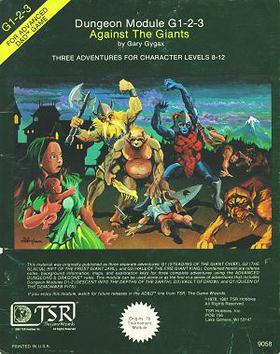
by Gary Gygax
32 pages
aka:
G1 Steading of the Hill Giant Chief
G2 Glacial Rift of the Frost Giant Jarl
G3 Hall of the Fire Giant King
Here is my collection of these, including some destroyed scraps:

These adventures originated as tournament adventures, for a three-round tournament. If you want to know how the adventure and its two sequels played at least for some groups, and have access to early issues or the Dragon Magazine Archive, you can find out. It's in The Dragon #19, p. 3-4 and 6-7.
The compilation G1-3 has what I gather are the nine original tournament PCs. Their levels and gear match the playtest report in The Dragon #19. They range from 9th (also a 5/8 F/M-U) to 14th level (a fighter with 104 HP and -5 AC) and are pretty well equipped, especially with healing potions and dust of disappearance. Stats are high - most have at least one 18, and the guy with only two 16s has 55 HP as a 12th level M-U (just short of max.) Naturally, there is also a dwarf with a +3 Dwarven Hammer and a Ring of Invisibility. Yowza. They're pretty serious adventurers. They do have some ridiculous names, though, like Fonkin Hoddypeak - which Gary Gygax would use as mild insults/terms of endearment in Saga of Old City.
G1 The Steading Of The Hill Giant Chief
G1 gets the series rolling, with the PCs tasked to punish some raiding giants who have seemed all too organized for hill giants, and to discover or what is the force behind them. There is no wilderness component - game start is right in front of the steading of hill giant chief. The PCs arrive just in time for a big to-do, so the guards they've been warned about aren't at the front door. It's set up with a "or else" by the nobles who sent the party that is much mocked online, but it always felt right to me - you're on a serious mission backed by equally serious folks.
The whole adventure is all of 8 pages with maps on the inside of the cover. But it packs a lot into those 8 pages. You get a giant's conference, a slave revolt, oppressed cave-dwellers, some hidden locations with bizarre things the giants and revolting slave orcs equally want nothing to do with, and plenty of action. There are all sorts of chances to use the environment for or against the PCs, and many sections where clever play can turn encounters into sources of information or even fight-ending moves. The adventure nicely deals with the possibility of "let's burn the place down!" and what will follow if the PCs do that, too, leaving little work for the GM to pick up after the fire and get things rolling.
Despite all of that, the adventure is largely hack-and-slash. A moderately thorough party that generally solves problems with direct combat, searches relatively well, and doesn't burn down obvious sources of intelligence (scrolls, maps, etc.) will be fine. It's no S1 Tomb of Horrors or S2 White Plume Mountain. Straight combat is the vast majority of the adventure. Good and interesting combat, but you can solve this one with swords and fireballs. The adventure pretty much rewards a mild sneak followed by extreme violence. The more alert foes in the later modules, though, punish that approach enough that you'd better get sneakier as you go and search a lot more thoroughly. While there are a couple of especially interesting areas, they aren't must-solve puzzles - and mostly fall into the "better off left alone" Gygaxian save-or-die type.
It's a complete adventure - almost nothing is left for the GM to determine at the last minute. It's done in the very old style of monster stat lines being nothing but HP, and the occasional "Fights as a frost giant" line. Which really does require a little extra prep by the GM, who not only needs to look up the HD, AC, etc. of hill giants and their various allies and slaves, but then to look up the HD of other monsters not in the adventure to cover the guys who "fight as a." It makes me pine for THAC0 when it showed up later in 1st edition AD&D modules. From experience, I can also tell you that for all three of these modules, you'll be much better off if you make a roster sheet, especially if the PCs raid, rest, and then return. The statlines from the back of the DMG are invaluable here.
It's got a lot of treasure, if you can either find the main stashes or wholly clear the place out. They include some Easter egg-like ones (like a giant slaying sword owned by one of the giant's guests . . . in case of treachery, perhaps). But you'll have to work for it. Not only that, but considering the level of the PCs - level 8-12, and the optimal mix suggested is 9 PCs of level 9 average. At those levels, a big pile of gold divided nine ways isn't going to be a major impact, and might just be needed to push PCs up levels as they go through the series. When your fighter needs 250,000 xp to level up, and the mage 375,000 xp, all the treasure they can carry away at 10 coins to the pound isn't going to amount to much.
G2 Glacial Rift of the Frost Giant Jarl
This one is also 8 pages, with maps on the inside of the cover. It details the multi-level rift of the frost giants and its inhabitants.
Hands-down, my favorite. Icy winds, fog if you throw fireballs (which is either good or bad, depending on the situation), slick floors, and lots of tough giants. It feels lived-in and it's tough. And it has two dragons in it, together. Plus hidden places with more loot and challenges, some required careful searching to even accomplish the first part of your goal - decapitating the giant's leadership - nevermind the second - finding out who is backing these giants. Again, lots of loot, but lots of really tough foes.
Like G1, there are a lot of little hooks here. There are odd bits - some frozen corpses set up to frighten intruders, but they're off to the side in a place easily bypassed. Against, it's hack-and-slash, although you need more searching to complete the adventure. There aren't any clever tricks or cunning traps, it's straightforward PCs vs. the monsters & the environment. And while slipping and creating fog with fireballs is covered, the module (in retrospect, surprisingly) doesn't discuss the cold. I never ran it with any concern for the PCs bundling up, which seems odd. I couldn't tell you off-hand if AD&D had any cold weather rules, but this would have been a good place for some chilling weather that slowly sapped away your ability to fight and limited your ability to rest and recover.
G3 Hall of the Fire Giant King
The finale of the series is 16 pages, with maps inside the cover fold.
This one is pretty amazing. Just about the toughest evil giants you can expect to encounter in groups - fire giants - and lots of allies. Ettins, gnolls, trolls, hell hounds, and pretty much every thematically fire-related monster. Plus - spoiler alert - it was the first appearance of the drow.
Like G1 and G2, there are hidden areas, places you can mess up and hurt yourself to no good purpose, and fights to avoid. There are places with things you should just not touch. There are potential allies here, too, mixed in with pretend allies. There are nasty set-piece fights and plenty of places for the giants to fight, retreat, and rally. Their clever allies means that the GM can really cut loose on the PCs even more than in G1 and G2, where the smartest guys in the room aren't that smart. It's a very difficult challenge for underequipped or tactically unsound PCs.
Like G1 and G2, it's complete and ready to go . . . mostly. Some treasure is underdetailed - scrolls and potions you need to roll up yourself, gems and jewelry you need to do the same for, and some magic items lacking important details (a sword you need to roll up, one suit of magic armor that doesn't even say what kind of armor it is.) Space must have been a concern, but you need to comb through and find and generate those ahead of time if you don't want to waste time at the table.
Overall
These are classics for a reason. Hard hack-and-slash with a purpose and a mission, high level play (like I said, one tournament PC was 14th level), and a lot of hooks and detail-inspiring wording throughout. They're complete and ready to go with minimal prep (except for those annoying "scroll of 7 sevens (determine randomly)" kind of treasure placements, mostly in G3.
The differences between G1-3 and G1, G2, and G3 are mostly art and some line spacings and such being tightened up so 32 pages could fit into 32 pages once one was dedicated to the tournament PCs.
These are amongst the best adventures Gary Gygax wrote, in my opinion. They cram a lot into a small wordcount and they're easy to drop in to a campaign.
I especially like the GM advice.
"There is considerable information contained herein which is descriptive and informative with respect to what the players see and do. Note that this does not mean that you, as Dungeon Master, must surrender your creatively and become a mere script reader. You must supply considerable amounts of additional material. You will have to make up certain details of areas. There will be actions which are not allowed for here, and you will have to judge whether or not you will permit them. Finally, you can amend and alter monsters and treasures as you see fit, hopefully within the parameters of this module, and with an eye towards the whole, but to suit your particular players."
That would be a great forward to any adventure, and should show up in your basic advice to new GMs. Hopefully a little more directly and clearly. Gary Gygax was amazing, but sometimes he pulled Vancian prose into what should have been technical writing. You can cut that down to something akin to "There is a lot of information here about what the PCs see and do. That doesn't mean the DM is a mere script writer - you can, will, and must supply considerable amounts of additional details. You will have to make up details, allow (or deny) actions not allowed for in the adventure, and otherwise referee the game as you see fit. Finally, feel free to change any monsters or treasures to fit your game." Something like that. But even unchanged, yes, that's extremely good advice on how to GM.
Good stuff, these adventures. If you don't have them and you're running AD&D or something close to it, I'd find them and play them.
Tomorrow I'll post some war stories, to avoid sticking spoilers in this review beyond what I've done so far.
If you like this review, you might like the consolidated Reviews page.
G1-3 Against the Giants
by Gary Gygax
32 pages
aka:
G1 Steading of the Hill Giant Chief
G2 Glacial Rift of the Frost Giant Jarl
G3 Hall of the Fire Giant King
Here is my collection of these, including some destroyed scraps:
These adventures originated as tournament adventures, for a three-round tournament. If you want to know how the adventure and its two sequels played at least for some groups, and have access to early issues or the Dragon Magazine Archive, you can find out. It's in The Dragon #19, p. 3-4 and 6-7.
The compilation G1-3 has what I gather are the nine original tournament PCs. Their levels and gear match the playtest report in The Dragon #19. They range from 9th (also a 5/8 F/M-U) to 14th level (a fighter with 104 HP and -5 AC) and are pretty well equipped, especially with healing potions and dust of disappearance. Stats are high - most have at least one 18, and the guy with only two 16s has 55 HP as a 12th level M-U (just short of max.) Naturally, there is also a dwarf with a +3 Dwarven Hammer and a Ring of Invisibility. Yowza. They're pretty serious adventurers. They do have some ridiculous names, though, like Fonkin Hoddypeak - which Gary Gygax would use as mild insults/terms of endearment in Saga of Old City.
G1 The Steading Of The Hill Giant Chief
G1 gets the series rolling, with the PCs tasked to punish some raiding giants who have seemed all too organized for hill giants, and to discover or what is the force behind them. There is no wilderness component - game start is right in front of the steading of hill giant chief. The PCs arrive just in time for a big to-do, so the guards they've been warned about aren't at the front door. It's set up with a "or else" by the nobles who sent the party that is much mocked online, but it always felt right to me - you're on a serious mission backed by equally serious folks.
The whole adventure is all of 8 pages with maps on the inside of the cover. But it packs a lot into those 8 pages. You get a giant's conference, a slave revolt, oppressed cave-dwellers, some hidden locations with bizarre things the giants and revolting slave orcs equally want nothing to do with, and plenty of action. There are all sorts of chances to use the environment for or against the PCs, and many sections where clever play can turn encounters into sources of information or even fight-ending moves. The adventure nicely deals with the possibility of "let's burn the place down!" and what will follow if the PCs do that, too, leaving little work for the GM to pick up after the fire and get things rolling.
Despite all of that, the adventure is largely hack-and-slash. A moderately thorough party that generally solves problems with direct combat, searches relatively well, and doesn't burn down obvious sources of intelligence (scrolls, maps, etc.) will be fine. It's no S1 Tomb of Horrors or S2 White Plume Mountain. Straight combat is the vast majority of the adventure. Good and interesting combat, but you can solve this one with swords and fireballs. The adventure pretty much rewards a mild sneak followed by extreme violence. The more alert foes in the later modules, though, punish that approach enough that you'd better get sneakier as you go and search a lot more thoroughly. While there are a couple of especially interesting areas, they aren't must-solve puzzles - and mostly fall into the "better off left alone" Gygaxian save-or-die type.
It's a complete adventure - almost nothing is left for the GM to determine at the last minute. It's done in the very old style of monster stat lines being nothing but HP, and the occasional "Fights as a frost giant" line. Which really does require a little extra prep by the GM, who not only needs to look up the HD, AC, etc. of hill giants and their various allies and slaves, but then to look up the HD of other monsters not in the adventure to cover the guys who "fight as a." It makes me pine for THAC0 when it showed up later in 1st edition AD&D modules. From experience, I can also tell you that for all three of these modules, you'll be much better off if you make a roster sheet, especially if the PCs raid, rest, and then return. The statlines from the back of the DMG are invaluable here.
It's got a lot of treasure, if you can either find the main stashes or wholly clear the place out. They include some Easter egg-like ones (like a giant slaying sword owned by one of the giant's guests . . . in case of treachery, perhaps). But you'll have to work for it. Not only that, but considering the level of the PCs - level 8-12, and the optimal mix suggested is 9 PCs of level 9 average. At those levels, a big pile of gold divided nine ways isn't going to be a major impact, and might just be needed to push PCs up levels as they go through the series. When your fighter needs 250,000 xp to level up, and the mage 375,000 xp, all the treasure they can carry away at 10 coins to the pound isn't going to amount to much.
G2 Glacial Rift of the Frost Giant Jarl
This one is also 8 pages, with maps on the inside of the cover. It details the multi-level rift of the frost giants and its inhabitants.
Hands-down, my favorite. Icy winds, fog if you throw fireballs (which is either good or bad, depending on the situation), slick floors, and lots of tough giants. It feels lived-in and it's tough. And it has two dragons in it, together. Plus hidden places with more loot and challenges, some required careful searching to even accomplish the first part of your goal - decapitating the giant's leadership - nevermind the second - finding out who is backing these giants. Again, lots of loot, but lots of really tough foes.
Like G1, there are a lot of little hooks here. There are odd bits - some frozen corpses set up to frighten intruders, but they're off to the side in a place easily bypassed. Against, it's hack-and-slash, although you need more searching to complete the adventure. There aren't any clever tricks or cunning traps, it's straightforward PCs vs. the monsters & the environment. And while slipping and creating fog with fireballs is covered, the module (in retrospect, surprisingly) doesn't discuss the cold. I never ran it with any concern for the PCs bundling up, which seems odd. I couldn't tell you off-hand if AD&D had any cold weather rules, but this would have been a good place for some chilling weather that slowly sapped away your ability to fight and limited your ability to rest and recover.
G3 Hall of the Fire Giant King
The finale of the series is 16 pages, with maps inside the cover fold.
This one is pretty amazing. Just about the toughest evil giants you can expect to encounter in groups - fire giants - and lots of allies. Ettins, gnolls, trolls, hell hounds, and pretty much every thematically fire-related monster. Plus - spoiler alert - it was the first appearance of the drow.
Like G1 and G2, there are hidden areas, places you can mess up and hurt yourself to no good purpose, and fights to avoid. There are places with things you should just not touch. There are potential allies here, too, mixed in with pretend allies. There are nasty set-piece fights and plenty of places for the giants to fight, retreat, and rally. Their clever allies means that the GM can really cut loose on the PCs even more than in G1 and G2, where the smartest guys in the room aren't that smart. It's a very difficult challenge for underequipped or tactically unsound PCs.
Like G1 and G2, it's complete and ready to go . . . mostly. Some treasure is underdetailed - scrolls and potions you need to roll up yourself, gems and jewelry you need to do the same for, and some magic items lacking important details (a sword you need to roll up, one suit of magic armor that doesn't even say what kind of armor it is.) Space must have been a concern, but you need to comb through and find and generate those ahead of time if you don't want to waste time at the table.
Overall
These are classics for a reason. Hard hack-and-slash with a purpose and a mission, high level play (like I said, one tournament PC was 14th level), and a lot of hooks and detail-inspiring wording throughout. They're complete and ready to go with minimal prep (except for those annoying "scroll of 7 sevens (determine randomly)" kind of treasure placements, mostly in G3.
The differences between G1-3 and G1, G2, and G3 are mostly art and some line spacings and such being tightened up so 32 pages could fit into 32 pages once one was dedicated to the tournament PCs.
These are amongst the best adventures Gary Gygax wrote, in my opinion. They cram a lot into a small wordcount and they're easy to drop in to a campaign.
I especially like the GM advice.
"There is considerable information contained herein which is descriptive and informative with respect to what the players see and do. Note that this does not mean that you, as Dungeon Master, must surrender your creatively and become a mere script reader. You must supply considerable amounts of additional material. You will have to make up certain details of areas. There will be actions which are not allowed for here, and you will have to judge whether or not you will permit them. Finally, you can amend and alter monsters and treasures as you see fit, hopefully within the parameters of this module, and with an eye towards the whole, but to suit your particular players."
That would be a great forward to any adventure, and should show up in your basic advice to new GMs. Hopefully a little more directly and clearly. Gary Gygax was amazing, but sometimes he pulled Vancian prose into what should have been technical writing. You can cut that down to something akin to "There is a lot of information here about what the PCs see and do. That doesn't mean the DM is a mere script writer - you can, will, and must supply considerable amounts of additional details. You will have to make up details, allow (or deny) actions not allowed for in the adventure, and otherwise referee the game as you see fit. Finally, feel free to change any monsters or treasures to fit your game." Something like that. But even unchanged, yes, that's extremely good advice on how to GM.
Good stuff, these adventures. If you don't have them and you're running AD&D or something close to it, I'd find them and play them.
Tomorrow I'll post some war stories, to avoid sticking spoilers in this review beyond what I've done so far.
If you like this review, you might like the consolidated Reviews page.
Friday, December 6, 2013
Random Stuff 12/6
Random stuff not sufficient to justify its own post . . .
- Dyvers Campaign has a really impressive blog listing. If you ever wonder what you are missing, odds are it is here. I am included, although, heh, I do seem to post a lot of GURPS. Go figure. ;)
- I am almost finishing assembling OGRE's 3-d counters. I am giving it the Sharpie treatment, which explains the time taken. I have about 3/4 of a grey sheet to go. Also the Vulcans, but I am skipping them. Sorry Vulcan fans, but I just don't see the attraction to them. To me, it feels like spending my time assembling tank-recovery models. I can't see really getting into using them. Am I missing something? They were added long after I stopped playing OGRE on a daily basis, so maybe I just don't see the awesomeness. To me Ogres are about firepower, not arms.
- It's a nice treat when my students get assigned stuff I like. I'm re-reading Beowulf, the Seamus Heaney bilingual edition, just to make sure I'm up on the canon they're writing about. Good stuff. I remember there was an old Dragon with three takes on Beowulf in AD&D terms . . . but for all I own the Dragon Archive, I can't find the issue number with search or archive. Weird.
- In theory, I have game this Sunday, which might mean another session report. But it's not clear yet who can make it, and December is always tough. If not, I'll provide another Felltower NPC's stats.
That's all for now.
- Dyvers Campaign has a really impressive blog listing. If you ever wonder what you are missing, odds are it is here. I am included, although, heh, I do seem to post a lot of GURPS. Go figure. ;)
- I am almost finishing assembling OGRE's 3-d counters. I am giving it the Sharpie treatment, which explains the time taken. I have about 3/4 of a grey sheet to go. Also the Vulcans, but I am skipping them. Sorry Vulcan fans, but I just don't see the attraction to them. To me, it feels like spending my time assembling tank-recovery models. I can't see really getting into using them. Am I missing something? They were added long after I stopped playing OGRE on a daily basis, so maybe I just don't see the awesomeness. To me Ogres are about firepower, not arms.
- It's a nice treat when my students get assigned stuff I like. I'm re-reading Beowulf, the Seamus Heaney bilingual edition, just to make sure I'm up on the canon they're writing about. Good stuff. I remember there was an old Dragon with three takes on Beowulf in AD&D terms . . . but for all I own the Dragon Archive, I can't find the issue number with search or archive. Weird.
- In theory, I have game this Sunday, which might mean another session report. But it's not clear yet who can make it, and December is always tough. If not, I'll provide another Felltower NPC's stats.
That's all for now.
Friday, November 16, 2012
Poisoning the Monsters
If you're going into a hole in the ground full of monsters to kill them, why aren't you using poison?
Those paragons of us-against-the-world ruthlessness did it:
That's just one example from those books - poisoned dart-shooters show up in Shadows Linger, too, and arrow poison in the Books of the South.
But what about in games?
I've heard a lot of arguments against it, some of which Jim Ward discusses here, while endorsing its use:
My players seems to agree with him. One of the two scouts has every single one of his arrows poisoned. Venom has come up in discussions of tactics. The real death-dealers skip it, only because they mostly don't need it to kill the monsters they most often fight, making it less cost effective.
But old-school AD&D pretty much stomped on poison use, and presented those objections raised in Mr. Ward's piece.
Still more can be found in the 1st edition PHB, 1st edition DMG, and even later D&D books like the 3.0 DMG. While the 1st edition DMG is a bit more generous than the others - it says assassins use poison "just as any other character classes" - but it still limits it a lot. It's got a lot of the same limitations on poison.
These are notably absent in GURPS Dungeon Fantasy 1, which makes poison a straight-up option on the equipment list, and the only benefit from being skilled in Poisons skill is the ability to use poison more effectively. Otherwise, it's assumed it is ready (and fairly straightforward) to use. Rolemaster had plenty of nasty, nasty things you could use on weapons, although mostly people were too busy lopping off limbs to pay money for poisons in my games.
But what about the objections in the AD&D books?
Some I don't buy, or buy only partly:
The poison will dry up and/or lose its effectiveness. Sure, maybe it will. So why not store it in breakable containers? If you say there aren't easy to transport but also easy to break containers, well, flaming oil is right out, too, potentially. So are pots of green slime and other sneaky tactics. Or just put it on before you enter the dungeon and stab something pretty quickly.
You can also take a leaf from The Wild Geese, and put breakable containers of venom (cyanide, in the movie) behind arrowheads. There is some suggestion that's how venom-using hunters do it. Maybe Gary Gygax was right and it'll dry out and won't stick to blades . . . but mixing up a sticky version might help, or alternate delivery methods can be used.
People will attack you. Seriously? The whole "hue and cry for the watch and then attack" bit is pretty funny. Joe the Blacksmith will attack the hulking barbarian because he was a poisoned sword? Yeah . . . that seems pretty smart. Your hirelings will jump you in the dungeon? Why?
The assassins guild will attack you? Why again? Competition? They want people to know if you die from poisoned wounds, they did it? Again, I can see them limiting sales to members, assuming there is even an assassin's guild, but what about the alchemist's guild? They might have something you can use as poison. Even merely biological agents - things that will putrefy wounds - or agents that will poison food - are useful against monsters. Does anyone mind if you put out poison food to kill basilisks or wipe out giant rats?
People will besmirch your honor. You have me here. They will, and they should, if you're using it in fair fights. I bet people don't describe "exterminating orcs" as a fair fight issue, or killing umber hulks as an issue of honor. But maybe they do, and you're sensitive to that. Well, honor has costs as well as benefits. Being a murder hobo does sometimes have advantages. Even more so, I bet they'd have an issue with the way you surprise attacked the orcs with a rank of hirelings behind you, the way you call those hirelings "meatshields," or the way you throw flaming oil and fireballs into rooms full of bandits because it's better than facing them one-on-one, or slit throats of Sleep spell victims, or use magical chemical agents (cloudkill in D&D, stench in GURPS). Look, most adventurers don't fight fair in the first place, so poison isn't a fairness issue. It's a social acceptance issue. You might be limited in appropriate targets, but I bet no one will complain if you use poison on predatory monsters.
You might cut yourself with your own weapon. Does this happen a lot? I mean, are you normally assumed to be slicing yourself with your blade on a regular basis? I'm pretty clumsy and I slice myself with my kitchen knife about, oh, once or twice a year. But my Broadsword-18 warrior might poison himself? My 9th level lord is has a 5% chance of poisoning himself (that's the 3.0 rule)? I just have trouble with this. Sure, blow a roll badly enough and hit yourself and you have a poison weapon? Sucks to be you. But it shouldn't be more dangerous to use than, say, a flaming sword or a vorpal blade.
It's a dangerous substance, but so are a lot of substances. Plus an insinuative poison - one that needs an open wound - isn't likely to also be a contact agent, so it's not necessarily automatically unsafe to get a little on you (assuming you wipe it off). Contact venom is more dangerous, but also less likely for use - against furry or scaled monsters, or armored men, contact venom isn't so helpful. Gas or blood agents are more easily delivered, and while gas is tricky (too easy to expose yourself to it) blood agents should be a little safer to handle with the usual adventurer gear of heavy gloves and suits of armor.
You need to know how to use it. I buy this, partially. You do need to know how to use it effectively. If you're just putting it on yourself with no expertise, you're likely to either use too much (and waste it), too little (and waste it), or put it on incorrectly (minimizing the effectiveness of the dose). The more readily available pre-measured doses and simple delivery systems are, the less of an issue this needs to be. And if magical elixirs come in perfectly pre-measured doses, it's not unreasonable venoms wouldn't come that way, too.
It's not fun/it makes the game too easy/it takes away from assassins. Basically the meta-game issues. The not fun part I sort-of get. Shoot it, it's going to die from the ounces of cobra venom you just delivered, so close the door and slink off for an hour and come back. Not the most fun.
The others, no so much. Too easy? Sure, if you have a ready supply of cheap save-or-die venom. So don't do that. The best venom in the book in Dungeon Fantasy 1 that is close to "save-or-die," Bladeblack, costs $1000 a dose - that's the entire starting funds for a PC for one dose. You might get some and use it, but not without some thought. The weakest is $20 a dose, and it's not a bad deal except it does very little damage and it's easy to resist. Worth adding but it's no game breaker. The "it takes away from assassins" bit is a bit more fair - but DF deals with this by making assassins more effective with venom. They can use their Poisons skill to put multiple doses on a single weapon so they take effect all at once. That alone makes it worth more - $80 worth of "Monster Drool" can hurt even a tough monster with strong resistance - and gives the assassin an edge. Not only that, but a lack of instant save-or-die venoms plus stronger monsters (in other words the important targets) means that the ones you most want to poison (dragons, et al) are the hardest to dispatch with poison.
The argument for poisons is pretty simple:
Hunting monsters is dangerous, you need every edge you can get. Yes, it is, and you do. If it's possible to get poison, why not use it? If you can get an effective venom that will hurt monsters you fight and aid your chances of success, and your character doesn't have some limitation that prevents it (Code of Honor, a Vow, or say, being a Paladin), think about putting some money into poisons. Heck, Jim Ward did it. He's pretty old school, isn't he?
Those paragons of us-against-the-world ruthlessness did it:
"Elmo, pick some good halbardier and crossbowmen. Quarrels to be poisoned."
- The Captain, in Glen Cook's The Black Company
That's just one example from those books - poisoned dart-shooters show up in Shadows Linger, too, and arrow poison in the Books of the South.
But what about in games?
I've heard a lot of arguments against it, some of which Jim Ward discusses here, while endorsing its use:
"Then there is the poison on the dagger trick, which every judge is always trying
to stop. I have been told that poisons evaporate, poisons exposed to the air lose
their effectiveness, or the most used of all, in your area there is no poison strong
enough to kill the things you want. I suggest to all you players and especially the
magic users that can use only daggers, that any amount of money and effort
spent in the procuring of a really effective poison is worth it. I spent over 90,000
gold and haven't regretted a copper piece of it."
- James M. Ward, "NOTES FROM A SEMI-SUCCESSFUL D&D PLAYER," The Dragon #13
My players seems to agree with him. One of the two scouts has every single one of his arrows poisoned. Venom has come up in discussions of tactics. The real death-dealers skip it, only because they mostly don't need it to kill the monsters they most often fight, making it less cost effective.
But old-school AD&D pretty much stomped on poison use, and presented those objections raised in Mr. Ward's piece.
Still more can be found in the 1st edition PHB, 1st edition DMG, and even later D&D books like the 3.0 DMG. While the 1st edition DMG is a bit more generous than the others - it says assassins use poison "just as any other character classes" - but it still limits it a lot. It's got a lot of the same limitations on poison.
These are notably absent in GURPS Dungeon Fantasy 1, which makes poison a straight-up option on the equipment list, and the only benefit from being skilled in Poisons skill is the ability to use poison more effectively. Otherwise, it's assumed it is ready (and fairly straightforward) to use. Rolemaster had plenty of nasty, nasty things you could use on weapons, although mostly people were too busy lopping off limbs to pay money for poisons in my games.
But what about the objections in the AD&D books?
Some I don't buy, or buy only partly:
The poison will dry up and/or lose its effectiveness. Sure, maybe it will. So why not store it in breakable containers? If you say there aren't easy to transport but also easy to break containers, well, flaming oil is right out, too, potentially. So are pots of green slime and other sneaky tactics. Or just put it on before you enter the dungeon and stab something pretty quickly.
You can also take a leaf from The Wild Geese, and put breakable containers of venom (cyanide, in the movie) behind arrowheads. There is some suggestion that's how venom-using hunters do it. Maybe Gary Gygax was right and it'll dry out and won't stick to blades . . . but mixing up a sticky version might help, or alternate delivery methods can be used.
People will attack you. Seriously? The whole "hue and cry for the watch and then attack" bit is pretty funny. Joe the Blacksmith will attack the hulking barbarian because he was a poisoned sword? Yeah . . . that seems pretty smart. Your hirelings will jump you in the dungeon? Why?
The assassins guild will attack you? Why again? Competition? They want people to know if you die from poisoned wounds, they did it? Again, I can see them limiting sales to members, assuming there is even an assassin's guild, but what about the alchemist's guild? They might have something you can use as poison. Even merely biological agents - things that will putrefy wounds - or agents that will poison food - are useful against monsters. Does anyone mind if you put out poison food to kill basilisks or wipe out giant rats?
People will besmirch your honor. You have me here. They will, and they should, if you're using it in fair fights. I bet people don't describe "exterminating orcs" as a fair fight issue, or killing umber hulks as an issue of honor. But maybe they do, and you're sensitive to that. Well, honor has costs as well as benefits. Being a murder hobo does sometimes have advantages. Even more so, I bet they'd have an issue with the way you surprise attacked the orcs with a rank of hirelings behind you, the way you call those hirelings "meatshields," or the way you throw flaming oil and fireballs into rooms full of bandits because it's better than facing them one-on-one, or slit throats of Sleep spell victims, or use magical chemical agents (cloudkill in D&D, stench in GURPS). Look, most adventurers don't fight fair in the first place, so poison isn't a fairness issue. It's a social acceptance issue. You might be limited in appropriate targets, but I bet no one will complain if you use poison on predatory monsters.
You might cut yourself with your own weapon. Does this happen a lot? I mean, are you normally assumed to be slicing yourself with your blade on a regular basis? I'm pretty clumsy and I slice myself with my kitchen knife about, oh, once or twice a year. But my Broadsword-18 warrior might poison himself? My 9th level lord is has a 5% chance of poisoning himself (that's the 3.0 rule)? I just have trouble with this. Sure, blow a roll badly enough and hit yourself and you have a poison weapon? Sucks to be you. But it shouldn't be more dangerous to use than, say, a flaming sword or a vorpal blade.
It's a dangerous substance, but so are a lot of substances. Plus an insinuative poison - one that needs an open wound - isn't likely to also be a contact agent, so it's not necessarily automatically unsafe to get a little on you (assuming you wipe it off). Contact venom is more dangerous, but also less likely for use - against furry or scaled monsters, or armored men, contact venom isn't so helpful. Gas or blood agents are more easily delivered, and while gas is tricky (too easy to expose yourself to it) blood agents should be a little safer to handle with the usual adventurer gear of heavy gloves and suits of armor.
You need to know how to use it. I buy this, partially. You do need to know how to use it effectively. If you're just putting it on yourself with no expertise, you're likely to either use too much (and waste it), too little (and waste it), or put it on incorrectly (minimizing the effectiveness of the dose). The more readily available pre-measured doses and simple delivery systems are, the less of an issue this needs to be. And if magical elixirs come in perfectly pre-measured doses, it's not unreasonable venoms wouldn't come that way, too.
It's not fun/it makes the game too easy/it takes away from assassins. Basically the meta-game issues. The not fun part I sort-of get. Shoot it, it's going to die from the ounces of cobra venom you just delivered, so close the door and slink off for an hour and come back. Not the most fun.
The others, no so much. Too easy? Sure, if you have a ready supply of cheap save-or-die venom. So don't do that. The best venom in the book in Dungeon Fantasy 1 that is close to "save-or-die," Bladeblack, costs $1000 a dose - that's the entire starting funds for a PC for one dose. You might get some and use it, but not without some thought. The weakest is $20 a dose, and it's not a bad deal except it does very little damage and it's easy to resist. Worth adding but it's no game breaker. The "it takes away from assassins" bit is a bit more fair - but DF deals with this by making assassins more effective with venom. They can use their Poisons skill to put multiple doses on a single weapon so they take effect all at once. That alone makes it worth more - $80 worth of "Monster Drool" can hurt even a tough monster with strong resistance - and gives the assassin an edge. Not only that, but a lack of instant save-or-die venoms plus stronger monsters (in other words the important targets) means that the ones you most want to poison (dragons, et al) are the hardest to dispatch with poison.
The argument for poisons is pretty simple:
Hunting monsters is dangerous, you need every edge you can get. Yes, it is, and you do. If it's possible to get poison, why not use it? If you can get an effective venom that will hurt monsters you fight and aid your chances of success, and your character doesn't have some limitation that prevents it (Code of Honor, a Vow, or say, being a Paladin), think about putting some money into poisons. Heck, Jim Ward did it. He's pretty old school, isn't he?
Monday, September 3, 2012
Snarfquest: The Book
Amongst the fairly odd stuff I have in my gaming collection is this book:
Snarfquest: The Book by Larry Elmore
Price: $9.95 back in the day (1987)
Snarfquest is a comic strip drawn by Larry Elmore.
I always liked the Snarf comic strip in Dragon, especially the first arc - collected here. It starts with the elder of a village of zeetvah (a snouted, bat-wing-eared humanoid race) pronouncing that their leader is dead, and whichever warrior of the village does the most heroic deeds in the next year will be proclaimed king. So Snarf heads out from his village to seek his fortune. It ends a 100+ pages later with his return after that year.
Not to spoil it (much), he encounters everything from Hot Warrior Women to evil wizards to dragons to a robot during his trip. The world is pretty recognizably D&Dish, although you don't get a lot of the "standard" races or monsters. Snarf isn't particularly murderous and likes to get where he can by wits more than brawn or skill. That helps keep the story moving along well without turning into a series of comic book brawls.
Larry Elmore gets a lot of crap for "static" or "posed" looking pictures. That may be true for his heroic landscape type art, but it's not true for his comic strip style Snarf art. The art is detailed (it's Elmore!) but dynamic and fun. It just goes to show his posed stuff is on purpose, not the only way the man can illustrate.
The book also has stats for the important characters in AD&D and BX D&D. The stats are complete, although sometimes they're odd - results from the comics wouldn't happen in game using the stats for stuff like the "magic wand" that Snarf has.
Is it worth getting? Probably not. You can read the classic Dragon magazine Snarfquest strips starting right here. The extra strip is interesting, but it might be around somewhere (I haven't found it, but I haven't dug all the way through Larry Elmore's site either). It's not likely you'll really need to known Snarf's Con or Suthaz's level, either, so the stats are just interesting rather than useful. Still, it's pretty fun, so if you love Elmore or love the Snarf strips, it might be worth looking into.
Snarfquest: The Book by Larry Elmore
Price: $9.95 back in the day (1987)
Snarfquest is a comic strip drawn by Larry Elmore.
I always liked the Snarf comic strip in Dragon, especially the first arc - collected here. It starts with the elder of a village of zeetvah (a snouted, bat-wing-eared humanoid race) pronouncing that their leader is dead, and whichever warrior of the village does the most heroic deeds in the next year will be proclaimed king. So Snarf heads out from his village to seek his fortune. It ends a 100+ pages later with his return after that year.
Not to spoil it (much), he encounters everything from Hot Warrior Women to evil wizards to dragons to a robot during his trip. The world is pretty recognizably D&Dish, although you don't get a lot of the "standard" races or monsters. Snarf isn't particularly murderous and likes to get where he can by wits more than brawn or skill. That helps keep the story moving along well without turning into a series of comic book brawls.
Larry Elmore gets a lot of crap for "static" or "posed" looking pictures. That may be true for his heroic landscape type art, but it's not true for his comic strip style Snarf art. The art is detailed (it's Elmore!) but dynamic and fun. It just goes to show his posed stuff is on purpose, not the only way the man can illustrate.
The book also has stats for the important characters in AD&D and BX D&D. The stats are complete, although sometimes they're odd - results from the comics wouldn't happen in game using the stats for stuff like the "magic wand" that Snarf has.
Is it worth getting? Probably not. You can read the classic Dragon magazine Snarfquest strips starting right here. The extra strip is interesting, but it might be around somewhere (I haven't found it, but I haven't dug all the way through Larry Elmore's site either). It's not likely you'll really need to known Snarf's Con or Suthaz's level, either, so the stats are just interesting rather than useful. Still, it's pretty fun, so if you love Elmore or love the Snarf strips, it might be worth looking into.
Tuesday, January 10, 2012
Dragon Magazine: The Wandering Damage Table
James Maliszewski doesn't seem to have gotten to this excellent article, so it's up to me to cover it.
From Dragon #96: The Meanest Of Monsters by Craig Kraus.
Mr. Kraus introduced us to two nasty monsters for the April Fools section of Dragon - the Killer Dungeon Master (who kills you dead, unfairly) and the Sleep-Inducing Dungeon Master (who bores you to sleep and then steals your dice).
The Killer Dungeon Master got to use the "Wandering Damage Table," a joke that really had legs for my gaming group and those of my local fellow players in other groups.
"How To Use The Wandering Damage System
First there was the wandering monster. They serve well when
applied in hordes, but why not cut out the middleman and just deal
out damage to the characters directly? It makes for a smoother,
faster-paced game, and if you want to kill off characters quickly, it
can only be beaten by divine intervention by Cthulhoid godlings."
You rolled on up to three tables - one to see what happened, one on the damage table (maybe), and one on the limb loss subtable.
Entries read like these:
"4 Your character cuts himself while shaving; consult Limb Loss
Subtable."
and
"11 Something invisible chews on your character, doing 6-36
points damage."
or
"13-20 Consult the Random Damage Subtable for no reason
whatsoever."
Or the Limb Loss Subtable, which included "Head gone" and "Torso cut in half." Yeah, from shaving perhaps - I had a razor like that once.
Or the damage subtable:
"01-05 Take 10 hit points damage.
06-10 Take 15 hit points damage."
or
"56-60 Take 24 hit points damage and then take 31 more.
61-65 Take 1,000 hit points damage and roll again.
66-70 Roll every die within 30 feet for damage."
I love "and then take 31 more."
"74-75 Take 3 hit points damage and consider yourself very lucky - for the time being."
Part of the humor for me was that I always saw wandering monsters as, pretty much, wandering damage. "You're taking too long, so here's some damage without treasure. Still lollygagging? Here's more!" We still refer to things as a "Wandering Damage Table." I roll for wandering monsters and say "Let's see if any wandering damage, er monsters, show up."
The other was the sheer quotability of "Consult the limb loss table" or "And consider yourself very lucky" in play. We must have busted these out once a session for years, and the elder gamers in my area still use these. A few of the younger guys picked it up without ever having seen Dragon #96. It's the "This one goes to 11" of gaming for us.
From Dragon #96: The Meanest Of Monsters by Craig Kraus.
Mr. Kraus introduced us to two nasty monsters for the April Fools section of Dragon - the Killer Dungeon Master (who kills you dead, unfairly) and the Sleep-Inducing Dungeon Master (who bores you to sleep and then steals your dice).
The Killer Dungeon Master got to use the "Wandering Damage Table," a joke that really had legs for my gaming group and those of my local fellow players in other groups.
"How To Use The Wandering Damage System
First there was the wandering monster. They serve well when
applied in hordes, but why not cut out the middleman and just deal
out damage to the characters directly? It makes for a smoother,
faster-paced game, and if you want to kill off characters quickly, it
can only be beaten by divine intervention by Cthulhoid godlings."
You rolled on up to three tables - one to see what happened, one on the damage table (maybe), and one on the limb loss subtable.
Entries read like these:
"4 Your character cuts himself while shaving; consult Limb Loss
Subtable."
and
"11 Something invisible chews on your character, doing 6-36
points damage."
or
"13-20 Consult the Random Damage Subtable for no reason
whatsoever."
Or the Limb Loss Subtable, which included "Head gone" and "Torso cut in half." Yeah, from shaving perhaps - I had a razor like that once.
Or the damage subtable:
"01-05 Take 10 hit points damage.
06-10 Take 15 hit points damage."
or
"56-60 Take 24 hit points damage and then take 31 more.
61-65 Take 1,000 hit points damage and roll again.
66-70 Roll every die within 30 feet for damage."
I love "and then take 31 more."
"74-75 Take 3 hit points damage and consider yourself very lucky - for the time being."
Part of the humor for me was that I always saw wandering monsters as, pretty much, wandering damage. "You're taking too long, so here's some damage without treasure. Still lollygagging? Here's more!" We still refer to things as a "Wandering Damage Table." I roll for wandering monsters and say "Let's see if any wandering damage, er monsters, show up."
The other was the sheer quotability of "Consult the limb loss table" or "And consider yourself very lucky" in play. We must have busted these out once a session for years, and the elder gamers in my area still use these. A few of the younger guys picked it up without ever having seen Dragon #96. It's the "This one goes to 11" of gaming for us.
Friday, October 28, 2011
Killer kobolds are bleh
Kobolds seem to be a pretty popular choice of opponents for low-level/starting adventurers to face. These days, they seem to be pretty nasty. They are still physically weak, but highly organized masters of unconventional warfare and special weaponry.
Looking back at my old D&D and AD&D stuff, I really don't see much implication that kobolds are nasty, guerrilla fighters with an expertise in traps, bushwacking, and hideous treachery. By D&D 3.0, they are fortifying their lairs with traps, dumping flaming oil on people, tossing vermin at you, etc., etc.
I blame Tucker's Kobolds.
That editorial in Dragon was the first mention I can remember where kobolds equaled more than "something the fighter can kill at one per level per round."
I liked the idea of fodder-level opponents who used trickery and nastiness to attack people. I went ahead and used that idea so viciously in my GURPS 1e campaign that mentioning the name of the critters I used automatically invokes comments about their sneaky tactics. But I didn't use kobolds, I used derro. The derro from S4 The Lost Caverns of Tsojcanth already were pictured as using numbers and sneakiness to fight stronger foes. So I used them. It was fun, and it was even more fun watching the players turn the tide eventually with even more sneaky and ruthless tactics. As recently as my last GURPS campaign I used bushwacking cannibal pygmies (now immortalized as Horde Pygmies in DFM1), but they were more harassers than a real threat, and they weren't meant to do much more than whittle at the edges of the PCs . . . the vampire wizard and her tiger pet were the real challenge in that session.
Using kobolds still seemed a bit lame. They're just cruel egg-laying reptile-dog humanoids with wimpy damage and little combat power. I just can't get excited about them.
When I see them now, they're always using traps, poison, flamethrowers, unleashed hideous beasts, pits full of pungi stakes and grey ooze, whatever. They're always so freaking nasty you can't wait to be done with them. Just like Tucker's Kobolds. And my reaction is like what I imagined a lot of people's would have been - man, I get it, you can make fodder tough. Now can I go have fun fighting powerful monsters instead of sucking flaming oil every Saturday?
But to me, that was still a later development. So they still just seem . . . bleh. Boring. Lame. As fodder for 1st level old-school RPG games, they seem okay. But as commando killers, it's too derivative for me, and it feels forced. I'd rather make a somewhat more formidable race of evil trapmakers than feel compelled to make pure fodder into a tool for "GM Proving His Cleverness" games. Why not do it with more powerful foes - why aren't mind flayers and duergar and orcs and imps like this? They should be setting traps and being nasty commandos, not fighting you straight-up if you're tougher.
I don't seem to be in the majority. For example, the excellent Dungeon Alphabet made the "K" entry into Kobolds.
I don't want to rag on people who like this, I'm just saying . . . Killer Kobolds don't do it for me. I like nasty tactics, but I find sticking them on kobolds derivative and lame, because kobolds are boring and weak. Is it just me?
Looking back at my old D&D and AD&D stuff, I really don't see much implication that kobolds are nasty, guerrilla fighters with an expertise in traps, bushwacking, and hideous treachery. By D&D 3.0, they are fortifying their lairs with traps, dumping flaming oil on people, tossing vermin at you, etc., etc.
I blame Tucker's Kobolds.
That editorial in Dragon was the first mention I can remember where kobolds equaled more than "something the fighter can kill at one per level per round."
I liked the idea of fodder-level opponents who used trickery and nastiness to attack people. I went ahead and used that idea so viciously in my GURPS 1e campaign that mentioning the name of the critters I used automatically invokes comments about their sneaky tactics. But I didn't use kobolds, I used derro. The derro from S4 The Lost Caverns of Tsojcanth already were pictured as using numbers and sneakiness to fight stronger foes. So I used them. It was fun, and it was even more fun watching the players turn the tide eventually with even more sneaky and ruthless tactics. As recently as my last GURPS campaign I used bushwacking cannibal pygmies (now immortalized as Horde Pygmies in DFM1), but they were more harassers than a real threat, and they weren't meant to do much more than whittle at the edges of the PCs . . . the vampire wizard and her tiger pet were the real challenge in that session.
Using kobolds still seemed a bit lame. They're just cruel egg-laying reptile-dog humanoids with wimpy damage and little combat power. I just can't get excited about them.
When I see them now, they're always using traps, poison, flamethrowers, unleashed hideous beasts, pits full of pungi stakes and grey ooze, whatever. They're always so freaking nasty you can't wait to be done with them. Just like Tucker's Kobolds. And my reaction is like what I imagined a lot of people's would have been - man, I get it, you can make fodder tough. Now can I go have fun fighting powerful monsters instead of sucking flaming oil every Saturday?
But to me, that was still a later development. So they still just seem . . . bleh. Boring. Lame. As fodder for 1st level old-school RPG games, they seem okay. But as commando killers, it's too derivative for me, and it feels forced. I'd rather make a somewhat more formidable race of evil trapmakers than feel compelled to make pure fodder into a tool for "GM Proving His Cleverness" games. Why not do it with more powerful foes - why aren't mind flayers and duergar and orcs and imps like this? They should be setting traps and being nasty commandos, not fighting you straight-up if you're tougher.
I don't seem to be in the majority. For example, the excellent Dungeon Alphabet made the "K" entry into Kobolds.
I don't want to rag on people who like this, I'm just saying . . . Killer Kobolds don't do it for me. I like nasty tactics, but I find sticking them on kobolds derivative and lame, because kobolds are boring and weak. Is it just me?
Wednesday, August 17, 2011
Monty Haul
(This is a re-post of something from my personal blog)
I've recently been reading through my Dragon Magazine PDF archive (GREAT product, really), getting myself ready for my upcoming DF game. Which is blatantly an excuse to use my AD&D and D&D and Rolemaster adventurers with my players. Again, since I've done that before.
What I went looking for was inspiration, and what I found the most in was the articles by James M. Ward.
He wrote the various "Monty Haul" articles. In modern parlance, a Monty Haul GM is a giveaway GM. He/she gives out ridiculous amounts of power for little danger, and makes the game basically a gimme-fest for the player(s). But James M. Ward (and "Monty") did it differently. You really want to run an Iron Golem fighter? Sure, go for it. Here's a vorpal sword for you. And a laser pistol. And the Ring of Gaxx and the Inestimable Jacinth of Beauty. What the hell, here are all of Vecna's body parts and 10 portable holes and a lifetime supply of Rings of Wishing. You'll need them.
That's right, you will. The games described are totally over the top, the enemies as close to totally unfair as you can get as saying "they automatically roll 20s to hit and maximum damage." But the players get a fair shot at beating them. If they do, the treasures are equally amazing - the unique artifacts of D&D canon, powerful items of all sorts (as mentioned, vorpal swords, laser weaponry, grenades, rings of wishing, etc.) But about half of the stories seemed to end with some variation of "we used wishes to get the hell out of there!" to save their precious high level characters.
It sounds really fun . . . and it sounds like exactly the stuff Gary Gygax wanted to expunge from the game when AD&D rolled along. It's the sort of stuff the Out on a Limb letters column responses bashed. It's explicitly spoken of as a bad thing - high level characters with almost abusive power levels against totally unfair monsters recovering ludicrous treasures.
Like I said, this is what I grew up learned was bad gaming. What Chad Underkoffler coined as "hurting wrong fun." Stuff you weren't supposed to be doing - but the people doing it seemed to be enjoying it.
James M. Ward sounds like the best sort of GM ever. The guy who gives you whatever you want but makes it never enough to do more than get by. The guy who always has something terribly awesome in store for you, game after game.
All in all, I'd have loved to play a D&D game with Gary Gygax before he died. But I think maybe a game of Metamorphosis Alpha or original D&D with James Ward would be more instructive . . .
I've recently been reading through my Dragon Magazine PDF archive (GREAT product, really), getting myself ready for my upcoming DF game. Which is blatantly an excuse to use my AD&D and D&D and Rolemaster adventurers with my players. Again, since I've done that before.
What I went looking for was inspiration, and what I found the most in was the articles by James M. Ward.
He wrote the various "Monty Haul" articles. In modern parlance, a Monty Haul GM is a giveaway GM. He/she gives out ridiculous amounts of power for little danger, and makes the game basically a gimme-fest for the player(s). But James M. Ward (and "Monty") did it differently. You really want to run an Iron Golem fighter? Sure, go for it. Here's a vorpal sword for you. And a laser pistol. And the Ring of Gaxx and the Inestimable Jacinth of Beauty. What the hell, here are all of Vecna's body parts and 10 portable holes and a lifetime supply of Rings of Wishing. You'll need them.
That's right, you will. The games described are totally over the top, the enemies as close to totally unfair as you can get as saying "they automatically roll 20s to hit and maximum damage." But the players get a fair shot at beating them. If they do, the treasures are equally amazing - the unique artifacts of D&D canon, powerful items of all sorts (as mentioned, vorpal swords, laser weaponry, grenades, rings of wishing, etc.) But about half of the stories seemed to end with some variation of "we used wishes to get the hell out of there!" to save their precious high level characters.
It sounds really fun . . . and it sounds like exactly the stuff Gary Gygax wanted to expunge from the game when AD&D rolled along. It's the sort of stuff the Out on a Limb letters column responses bashed. It's explicitly spoken of as a bad thing - high level characters with almost abusive power levels against totally unfair monsters recovering ludicrous treasures.
Like I said, this is what I grew up learned was bad gaming. What Chad Underkoffler coined as "hurting wrong fun." Stuff you weren't supposed to be doing - but the people doing it seemed to be enjoying it.
James M. Ward sounds like the best sort of GM ever. The guy who gives you whatever you want but makes it never enough to do more than get by. The guy who always has something terribly awesome in store for you, game after game.
All in all, I'd have loved to play a D&D game with Gary Gygax before he died. But I think maybe a game of Metamorphosis Alpha or original D&D with James Ward would be more instructive . . .
Subscribe to:
Posts (Atom)
